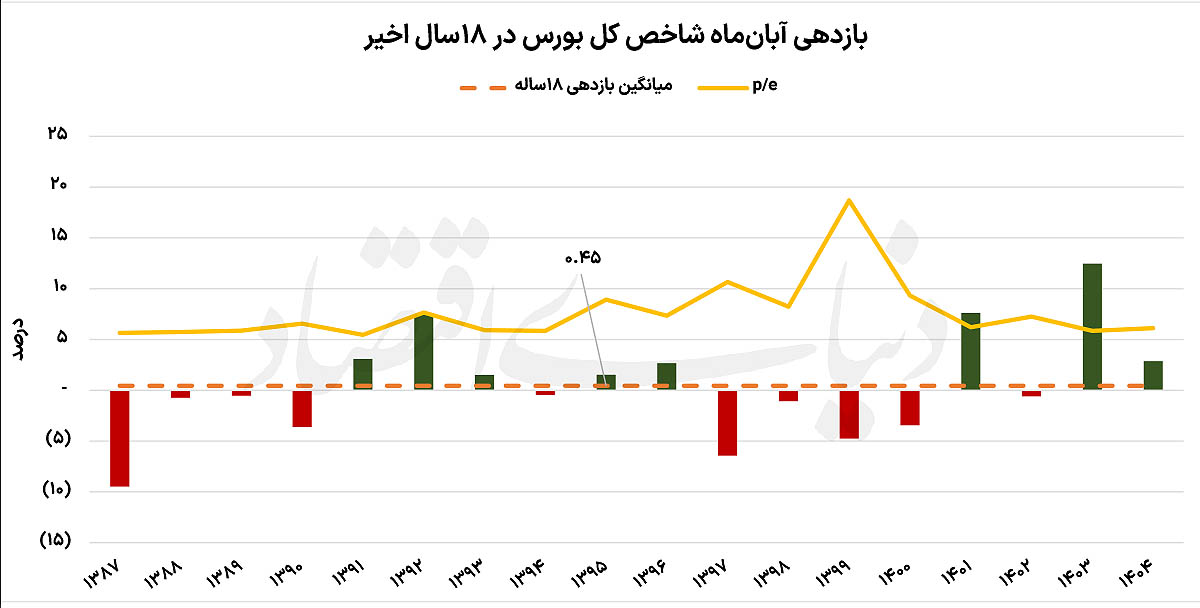
Ali Ghasemi: The overall stock index, based on historical data, has not experienced very pleasant Abans. In the past 18 years, the average return of the main stock market indicator in the eighth month of the year has been about 0.5 percent. Also, the probability of recording positive and negative returns in this month is almost equal — statistics that speak of the difficulty of predicting the stock market's path in the second month of autumn. For this reason, it seems the capital market will also face a set of risks and opportunities in this year's Aban. The publication of suitable reports by listed companies and the adjustment of the market's price-to-earnings (P/E) ratio from the range of 10 to 7.3 units are among the factors that have strengthened the value of stocks. In contrast, an increase in political and military risks can temporarily accompany markets, including the Tehran Stock Exchange, with turbulence. An examination of the market's historical course shows that the value status of stocks at the beginning of Aban can also play an important role in determining the path of the indices. In other words, although a decrease in the P/E ratio to lower ranges increases the capacity for price growth, the realization of this capacity still depends on political conditions, investors' expectations and companies' profitability outlook.
An Equal Probability of Rise and Fall
Unlike some months of the year in which the overall stock index has had a positive performance and a greater probability of recording an upward return, Aban has been a month with a variable and turbulent track record for the capital market. An average return close to zero in this month shows that the stock market's historical performance in Aban, rather than speaking of a stable upward or downward trend, has been influenced by the specific economic and political conditions of each year. In such an atmosphere, examining the average return alone cannot present a complete picture of the market's status, and attention to the reasons behind the formation of positive and negative returns is also important. In years when the stock market has been able, with the adjustment of the P/E ratio and the publication of suitable company reports, to preserve part of its value, a better performance has been recorded in the eighth month of the year. However, historical data show that even under these conditions, achieving a considerable positive return in Aban is not very common. Except for the years 1401 and 1403, when a powerful rally befell the overall stock index, considerable positive returns have been less observed in this month. This shows that Aban's strong growths have in cases been connected with the market's special conditions and not merely the seasonal characteristics of trading.
In both of the years mentioned, the overall stock index, before entering Aban, had lost part of its value under the influence of political risks and price declines. The decrease in stock prices and the adjustment of valuation ratios paved the way for the return of demand. In fact, when stock prices reach lower levels compared with companies' profitability outlook, with the decrease in selling pressure and the improvement of expectations, the possibility of upward waves forming increases. In this regard, the stock market's P/E ratio in both of the years mentioned had reached the range of 6 units or lower — a level that, from a valuation perspective, provided more capacity for prices to return.
Of course, this experience does not mean that a severe market decline in the preceding months will lead to stock market growth in Aban. The value of stocks can pave the way for the return of demand, but alone it is not sufficient for the start of a stable upward trend. The status of economic variables, companies' profitability outlook and the degree of investors' confidence in the future also play a role in the realization of this scenario. Therefore, one cannot, merely by relying on the experience of the years 1401 and 1403, expect the stock market to record a similar return in this year's Aban either.
On the opposite side, the probability of recording considerable negative returns in this month's historical track record is not small either. In some years, the combination of political risks, concern about economic developments and the formation of a price bubble in the stock market has driven investors to increase caution and stand on the sell side of trades. An examination of the market's course in the years 1398 to 1400 shows that a high or unconventional P/E ratio, alongside some political risks, domestic unrest and international developments, was accompanied by price declines and the recording of negative returns.
Under such conditions, stock prices' distance from fundamental variables and the increase in unrealistic expectations can heighten the market's sensitivity to negative news. When a considerable part of price growth has already been reflected in stocks' value, the publication of unfavorable news or an increase in uncertainties may lead to a rapid change in expectations and an intensification of selling pressure. For this reason, examining the market's valuation status alongside political developments has special importance for evaluating the stock market's outlook in Aban.
The Narrow Line Between Winning and Losing
In this year's Aban as well, the simultaneity of political risks on the one hand and the publication of suitable company reports on the other has created dual conditions for the stock market. On the one hand, the six-month reports and the considerable growth in companies' profitability this summer caused the stock market's P/E ratio to be adjusted from the range of 10 units in mid-Mehr to 7.3 units. On the other hand, the continuation of political and military uncertainty can prevent the decrease in valuation ratios from leading to a sustainable increase in demand. As a result, the market is in conditions where both signs of improving value are seen in it and deterrent factors exist that can affect the path of prices.
At first glance, a decrease in the P/E ratio means stocks' prices becoming more attractive relative to companies' expected profitability.
When companies' profits increase and stock prices do not grow at the same speed, the price-to-earnings ratio decreases. Such a change can draw the attention of fundamental investors to the market — especially if the growth in profitability in company reports has operational backing and is not the result of temporary factors. From this perspective, this year's six-month reports can be a basis for a more precise evaluation of companies' profitability capacity in the second half of the year.
However, a lowering of the P/E ratio does not mean the end of the market's risks. This ratio depends on expectations about future profitability, and if the outlook of companies' activity changes, even despite a decrease in stock prices, their valuation status may not be very attractive. For example, an intensification of political and military uncertainty can affect investors' expectations, production costs, exports and the sales outlook of some industries. In such an atmosphere, investors may demand a higher expected return for accepting more risk, and this very thing leads to a decrease in valuation ratios.
For this reason, a P/E ratio in the range of 7.3 units cannot alone be considered a definite sign of the value of all stock symbols. Among different industries and companies, there are meaningful differences in terms of the durability of profitability, the degree of exposure to political and economic risks, and the sales growth outlook. As a result, a decrease in the overall market's P/E ratio can lead to a sustainable improvement in trading when companies' profitability growth continues and investors also gain more confidence about the outlook of firms' activity.
Another important point is the difference between fundamental value and the right time to enter the market. Even if stock prices are attractive compared with companies' profitability, an increase in external risks can lead to price declines in the short term. The experience of past years also shows that in Aban, the stock market has reacted to the conditions prevailing over the market and the developments of that period more than it has followed a specific seasonal pattern. Therefore, one cannot consider the historical average return of close to zero as a definite prediction of the market's performance in this year's Aban.
On this basis, investors are advised to also consider the probability of a market correction in their decisions and not act merely on the basis of a decrease in the P/E ratio or the positive performance of some industries. Attention to the quality of companies' profits, the difference in the fundamental status of industries, and the degree of risk tolerance can have greater importance in managing capital than predicting a specific return for the whole market. This year's Aban, like many past Abans, is a month in which the line between positive and negative returns is not very bold — a month whose trading outcome will probably depend, more than anything, on the balance between stocks' value and the intensity of external uncertainties.
Source: Donya-e-Eqtesad