The Majlis Research Center has recently, in a report titled "Review and Analysis of the Performance of Supportive Employment Facilities", evaluated this policy, the goal of whose implementation is to create income for vulnerable households and empower them. However, the evidence shows that the allocation of resources has not been based on the degree of deprivation of the provinces, and the average number of employed persons in the lower income deciles has not increased much. Similarly, income derived from employment in the lower deciles has not grown much compared with other income deciles, because the economic governance system's attention is on the amount of resources absorbed, not on removing deprivation and empowerment. Resources are distributed without performance evaluation and based on political bargaining between the custodian institutions, and also marketing, training, job counseling and the correct identification of target groups have been neglected. Based on the statistics presented in this report, the per-capita number of people with jobs in the lower deciles of the country is greater than in the higher deciles, and this indicates that employment has not necessarily led to an improvement in the situation of the poor individual. In the report's view, the existing weaknesses do not stem merely from the performance of one or a few bodies, but go back to the policymaking structure, the multiplicity of custodian institutions, the absence of a clear division of labor, the dispersion of responsibilities, and the lack of an integrated oversight system. Under such conditions, increasing credits or changing budget rulings alone cannot guarantee the policy's effectiveness. For this program to succeed, financial resources must be linked with training, skill-building, job counseling, marketing and access to the market.
The Course of Budget Developments and the Expansion of Resources
Supportive employment facilities, in the years under review, have gradually expanded in terms of the volume of resources and the number of receiving institutions. In the years 1396 and 1397, respectively 6 and 4 trillion tomans were considered for this purpose. This figure increased to 10 trillion tomans in 1398, and in 1399, despite the approved resources decreasing to 8 trillion tomans, the range of implementing institutions expanded. In 1400, the anticipated resources reached 28 trillion tomans and encompassed more groups, including veterans, soldiers after the end of their service, innovative businesses, creative industries and knowledge-based activities. In 1401, the total resources of qard al-hasan employment facilities reached 102 trillion tomans, of which 62 trillion tomans had been considered for provincial distribution. Also, the Ministry of Cooperatives, Labour and Social Welfare undertook the responsibility of monitoring supportive employment, and the registration of information in the relevant system was emphasized.
Supportive employment policy in recent years has been pursued with an increase in financial resources and the expansion of implementing institutions. In 1402, the resources related to this policy reached about 105 trillion tomans, and for the years 1403 and 1404, a total of 1 million billion rials in qard al-hasan facilities was anticipated. In 1403, 40 percent of the resources were allocated to the provincial Progress and Justice accounts and 60 percent to the designated institutions. In 1404 as well, 40 trillion tomans were considered for the provincial accounts and 60 trillion tomans with priority for women heads of household. Nevertheless, the report shows that this policy still lacks a sustainable strategy, measurable goals and an effective evaluation system. The frequent changes in budget laws and the bodies' competition to absorb credit have not necessarily led to an improvement in the quality of employment either.
The Disproportion Between the Degree of Deprivation and the Amount Paid
One of the main problems is the lack of proportion between the degree of deprivation of regions and the resources allocated to them. The allocation of credits has been influenced more by the executive capacity and the ability of bodies to absorb resources than by the intensity of poverty and unemployment. Also, the multiplicity of implementing institutions — including the Relief Committee, the State Welfare Organization, the Barakat Foundation, the Mostazafan Foundation and Basij Sazandegi — has led to a dispersion of responsibilities and an overlap of duties. Meanwhile, financing has had greater priority than skills training, job counseling, marketing and connecting producers to the market. The absence of an integrated monitoring system has also made it difficult to evaluate the bodies' performance and to assess the cost-benefit of the facilities. The performance of past years also shows the limitations of this policy. In 1401, of the 62 trillion tomans of resources anticipated for provincial distribution, only about 11 trillion tomans, equivalent to 18 percent, was paid. For these facilities, the creation of employment for about 98,287 people had been anticipated. Services, agriculture, home businesses and industry, respectively, held major shares of the absorbed resources, but the available information does not specify what amount of these supports led to sustainable employment.
In 1402, the performance of supportive institutions in absorbing resources was about 72 percent; the Barakat Foundation absorbed 93 percent of its resources, while this figure for the Innovation and Prosperity Fund was about 45 percent. At the provincial level too, there was a striking difference. In 1403, no clear proportion was observed between the amount of resources absorbed and the employment-creation commitments of some bodies. Also, at the time of the review, the final performance of the 1404 facilities could not be evaluated because the resources had not been deposited into the accounts of the relevant institutions. These findings show that the amount of credit absorption alone is not a suitable criterion for measuring success.
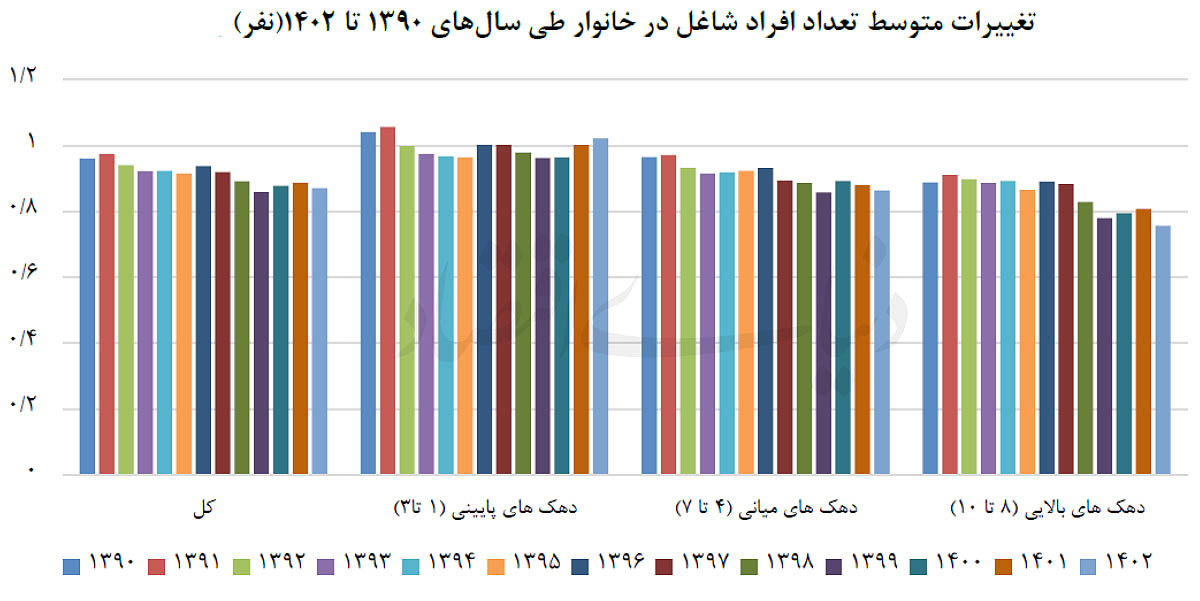
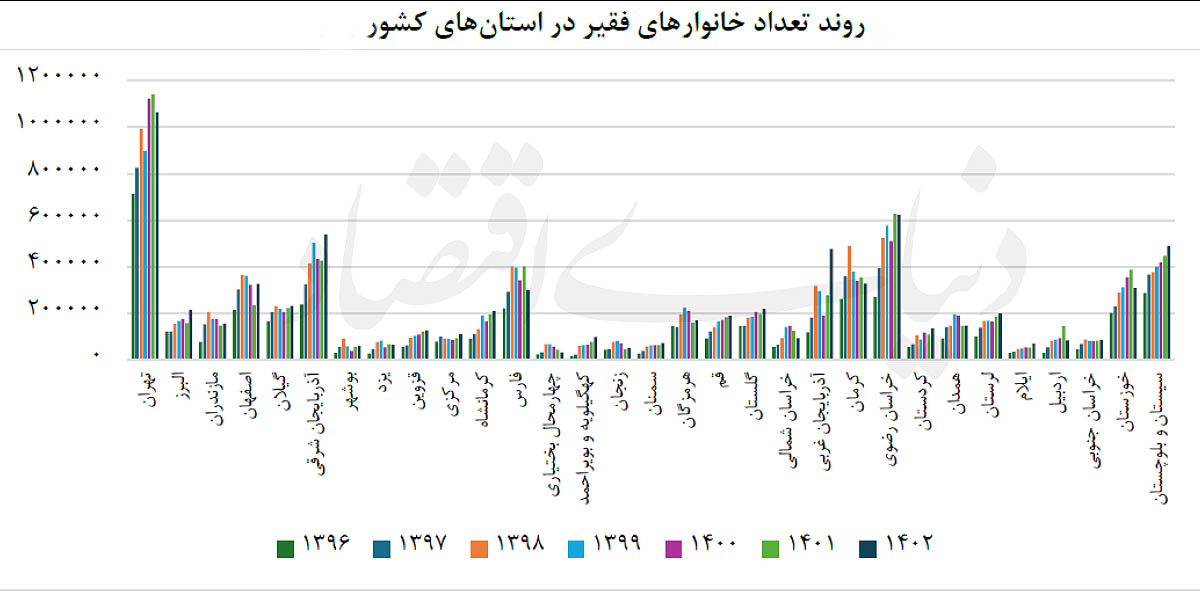
An examination of household data in the years 1390 to 1402 shows that the average number of employed persons in the middle deciles has remained almost constant, and in the lower deciles too, the increase in employment in the years 1401 and 1402 was limited. The share of households without an employed person has increased, and the real income of self-employment in the lower deciles has still been less than in the higher deciles. The income of home businesses has also had an unstable course. At the same time, the number of poor households has increased in many provinces, and the more deprived provinces have generally had weaker performance in absorbing credits — a situation that can be related to limited infrastructure and executive capacity.
Regarding women heads of household, the real income of self-employment has had an overall increasing course since 1399, but the income of home businesses has shown more fluctuation. A focus on low-yield activities, such as small-scale sewing and handicrafts, intensifies this group's income-generation limitations. Also, part of the facilities may be spent on the household's essential expenses instead of productive investment. In sum, the effectiveness of supportive employment depends on reforming the method of resource allocation, paying more attention to deprived regions, determining clear responsibilities for institutions, and creating a results evaluation system. Complementing financial facilities with new skills training, access to the market, cheaper inputs and insurance support, especially for women heads of household, can increase the probability of converting a loan into sustainable employment and an increase in real income.
Policy Recommendations
The Majlis Research Center considers it necessary, for reforming the supportive employment policy, to formulate a national strategy with clear goals and measurable indicators. The Supreme Council of Employment must specify the bodies' responsibilities and organize the division of labor among the custodian institutions based on their capacity and expertise in fields such as financing, training, skill-building, counseling and marketing. Also, the resource allocation system must be reformed based on the intensity of deprivation, the needs of target groups and the executive capacity of regions. The weak performance of a deprived region must not lead to a further reduction of its share of resources; rather, the obstacles to absorbing credit in that region must be identified and removed. Creating an integrated information system is also important for the online registration of facilities, oversight of the bodies' performance and identifying the diversion of resources.
More important than all, performance evaluation must go beyond the amount of facilities paid and encompass the number of jobs created, the durability of employment, the increase in households' real income, and changes in the poverty situation. Financial support must also be accompanied by training, job counseling, marketing, access to raw materials and connection to sales networks. Attention to knowledge-based jobs and emerging activities with higher added value can also help create more sustainable income. The report considers Article 6 of the Law of the Seventh Development Plan and the executive structure anticipated in it a suitable capacity for reforming this policy. The report's main message is that the success of supportive employment is measured not by the amount of credit allocated, but by the creation of sustainable employment, increased real income and reduced deprivation. Achieving this goal requires moving beyond the purely credit-based approach and moving toward an integrated program that links financing with empowerment, oversight and evaluation of results.
Source: Donya-e-Eqtesad