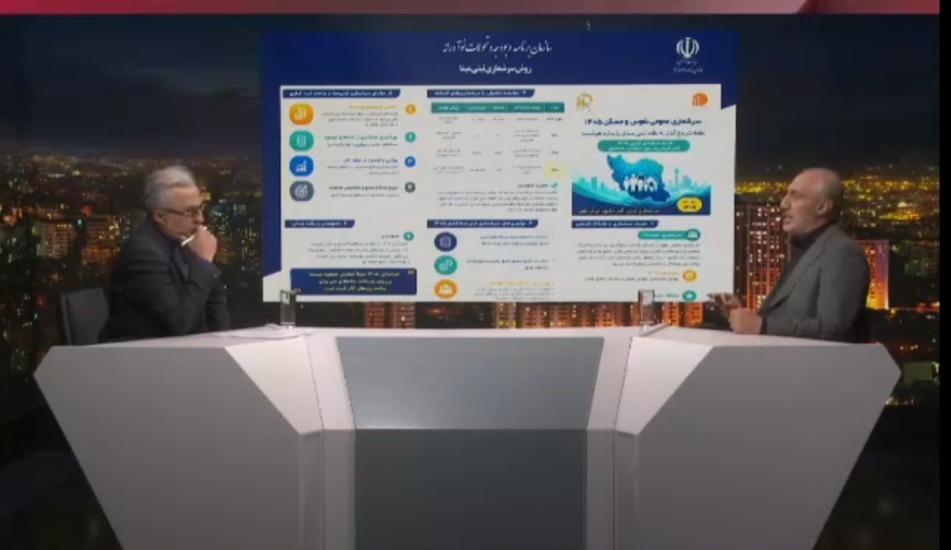
Young Journalists Club; Mahboubeh Kabari - Hamid Pourmohammadi, head of the country's Plan and Budget Organization, referring to the change in the method of conducting the general population and housing census, said: The census in Iran since the 1950s has been conducted periodically, once every 10 years, and its last round was held in 2016. The 2026 census counts as the third phase of the transformation in the country's census method, in which the register-based method has replaced extensive visits to homes.
He added: In the methods used before, census enumerators, by visiting people's homes and completing paper questionnaires or using tablets, collected household information; but in the new method, the data existing in the systems of government agencies is aggregated and, after review, matching and fixing of deficiencies, becomes the basis of the census
Pourmohammadi, stating that merely aggregating the information in the systems is not sufficient for conducting the census, stated: Some of the information present in the systems is incomplete, contradictory or ambiguous; therefore, the data must be matched with one another so that deficiencies and inconsistencies that may exist are removed. In this year's census, with this mechanism, about 80 percent of the required information was obtained through the systems.
The head of the country's Plan and Budget Organization, referring to the advantages of the register-based method, said: One of the important results of this change is a significant reduction in the costs of the census. In the previous round, about 33,000 census enumerators were employed across the country, and providing the equipment they needed, including tablets, support and facilities, entailed considerable costs; but in the new method, the bulk of the information is gathered through the systems.
He added, referring to the increased capacity for accuracy in this method: In the register-based census, information is available in greater detail and the possibility of matching the data of various agencies is provided. According to Pourmohammadi, the data of more than 30 executive agencies has been aggregated at the Plan and Budget Organization and matched with one another; a measure that, in addition to identifying data deficiencies, helps agencies keep their information up-to-date and more accurate.
Pourmohammadi continued: Information on civil registration, vehicles, housing and other fields is matched with one another in this process and this convergence can reveal the deficiencies present in the various systems.
The head of the country's Plan and Budget Organization, explaining the process of resolving ambiguities in household information, said: In examining the information, five main axes have been identified for resolving ambiguity, including flaws in the national code, the postal code not being precise, discrepancies in the number of household members, the information on cooling and heating appliances being unclear, and ambiguity in the state of housing wear.
He added: For households whose information in these areas needs correction, an SMS has been sent so they can make their information precise. Responses to these cases are made via SMS and the goal is that the information related to the status of households and the needs of society be recorded with greater precision.
Pourmohammadi, referring to the next stage of conducting the census, said: After this stage ends, about 3,000 enumerators will visit part of the population for field review. In this stage, about five percent of the population is targeted, and the information of households in which the probability of a serious flaw in the data is higher will be reviewed through in-person visits and completion of a questionnaire.
He also announced the visit of census enumerators to about 1,300,000 households and said: The information of these households will be completed in the form of a questionnaire and in the field, so that the remaining deficiencies in the information-registration process are removed.
Census; the basis of planning for the needs of society
The head of the country's Plan and Budget Organization, emphasizing the importance of the census in macro planning, said: Population counting and information gathering is a prelude for society's people to be seen in the planning system. For example, in a village we must know how many children, young people and elderly people live there, so that on that basis, planning can be done for building schools, developing treatment services and providing the people's other needs.
He added: Knowing the trend of population migration is also important; because it must be determined from which areas people migrate and which areas face population increase and greater need for public services. On this basis, precise population information can be the basis of decision-making in fields such as treatment, housing and infrastructure development.
Pourmohammadi, referring to the importance of recording information related to the housing situation, said: Identifying dilapidated houses helps the government plan for retrofitting buildings against earthquakes. Also, information related to households' cooling and heating appliances can be effective in identifying energy consumption patterns and designing support programs and consumption reform.
He stated: In total, census information, after being collected, matched and analyzed, helps the government achieve the best result, at the lowest cost, in planning and resource allocation.
The head of the country's Plan and Budget Organization, referring to Iran's standing in implementing this method, said: According to him, in Asia, before Iran, four countries — Turkey, Indonesia, Singapore and South Korea — moved toward implementing a register-based census; with the difference that the quality of implementing this method in some of them was lower than the level sought by Iran.
Pourmohammadi added: In total, about 19 countries in the world have been able to turn to this census method, and Iran counts as the twentieth country in this field. According to him, implementing this method can, while reducing costs, provide the ground for increasing the precision of information and improving planning in the country.
The necessity of reviewing the mechanism for financing the health sector
Pourmohammadi, in another part of his remarks, referring to the costs of the health and treatment field, said: One of the important concerns of the government is the increase in the costs of treatment and the share paid by the people. At present, about three billion dollars of preferential currency is allocated in this field and the government also spends other resources on health insurance, health services and paying the salaries of treatment staff; however, the costs that patients pay continue to increase.
He added: This situation shows that despite the allocation of considerable resources, the current mechanism has not been able to fully achieve the intended goals. Therefore, in the course of drafting next year's budget, the Plan and Budget Organization and the Ministry of Health must reach an agreement on reforming the financing method and the manner of allocating resources.
The head of the country's Plan and Budget Organization, emphasizing the necessity of reforming the referral system, said: Part of the costs of the current health system may not have the necessary effectiveness. It must be specified which services need a specialist physician and which cases can be pursued through general practitioners. It is also necessary to review the amount of drug prescription and the manner of resource use in this sector.
Pourmohammadi stated: The goal is that support resources and preferential currency be allocated in a manner such that it reaches the main beneficiary, and the increase in unnecessary costs and the role of multiple intermediaries is prevented. The government, in interaction with the health insurance sector and the Ministry of Health, pursues the reform of these mechanisms.
Attention to the livelihood of employees and pensioners in the 1406 budget
He further, referring to the approaches of the 1406 budget, said: Next year's budget, in terms of approaches and definitions, will have differences with the 1405 budget. Given the inflationary conditions and livelihood pressures, the living situation of government employees and pensioners must be given more attention.
Pourmohammadi added: Alongside this issue, it is necessary for the government's resources and expenditures to be reviewed in proportion to economic developments. Also, part of the country's employees, in terms of the amount they receive, are in an unfair situation, and a way must be thought out to reduce these inequalities and move toward justice in payments.
The head of the country's Plan and Budget Organization, about the time of presenting next year's budget bill to the parliament, also said: The plan is for the 1406 budget bill to be presented to the Islamic Consultative Assembly in the month of Azar.
Pourmohammadi's request to the people for a 10 percent reduction in gas consumption
Pourmohammadi, in the final part of his remarks, referring to the approach of the cold season of the year, asked the people to manage their consumption in order to prevent problems in the country's gas supply.
He said: The country, on the threshold of the cold season, faces a gas imbalance, and part of the gas infrastructure had also been damaged during the war. Although with the efforts of the colleagues of the Ministry of Petroleum and the National Iranian Gas Company, part of this damage has been compensated, gas consumption must be managed from right now in order to pass through the winter.
The head of the country's Plan and Budget Organization added: If we can reduce gas consumption by about 10 percent, the possibility of passing through the conditions ahead with less difficulty will be provided. In contrast, not observing the consumption pattern can exert great pressure on the network, and under pressure-drop conditions, the probability of problems arising in gas supply to different regions increases.
He, stating that cutting gas under severe cold conditions can confront people's lives with serious difficulty, said: I request the people to help pass through these conditions with thrift and cooperation, and to think of their fellow countrymen who live in cold regions. Also, the media, in particular the IRIB, can play an effective role by culture-building in the field of optimal energy consumption.
Pourmohammadi, referring to the results of the actions carried out for managing energy consumption, said: With the planning and cooperation of agencies and the people, the growth in consumption of some energy carriers has stopped, and in some sectors the consumption trend has become declining. According to him, the growth in gasoline consumption, which was previously about seven percent, has also stopped, and diesel consumption has also had a declining trend.
In the end, he expressed hope that with the continued cooperation of the people and executive bodies, the consumption-management trend will also extend to gas, so that the country can get through the cold season with the fewest problems.


No comments yet — be the first to share your view.