Zarif's Recollection of Seyed Kamal Kharrazi's Role in Resolution 598 and the Trip to the Island of Gotland / Martyr Kharrazi Emphasized Preserving the Role of the United Nations
Mohammad Javad Zarif, the former foreign minister, described rationality, composure, devoutness and respect for the rights of others as among the outstanding traits of Martyr Seyed Kamal Kharrazi and emphasized that humanity and devoutness held a special place in the personality of this distinguished diplomat.
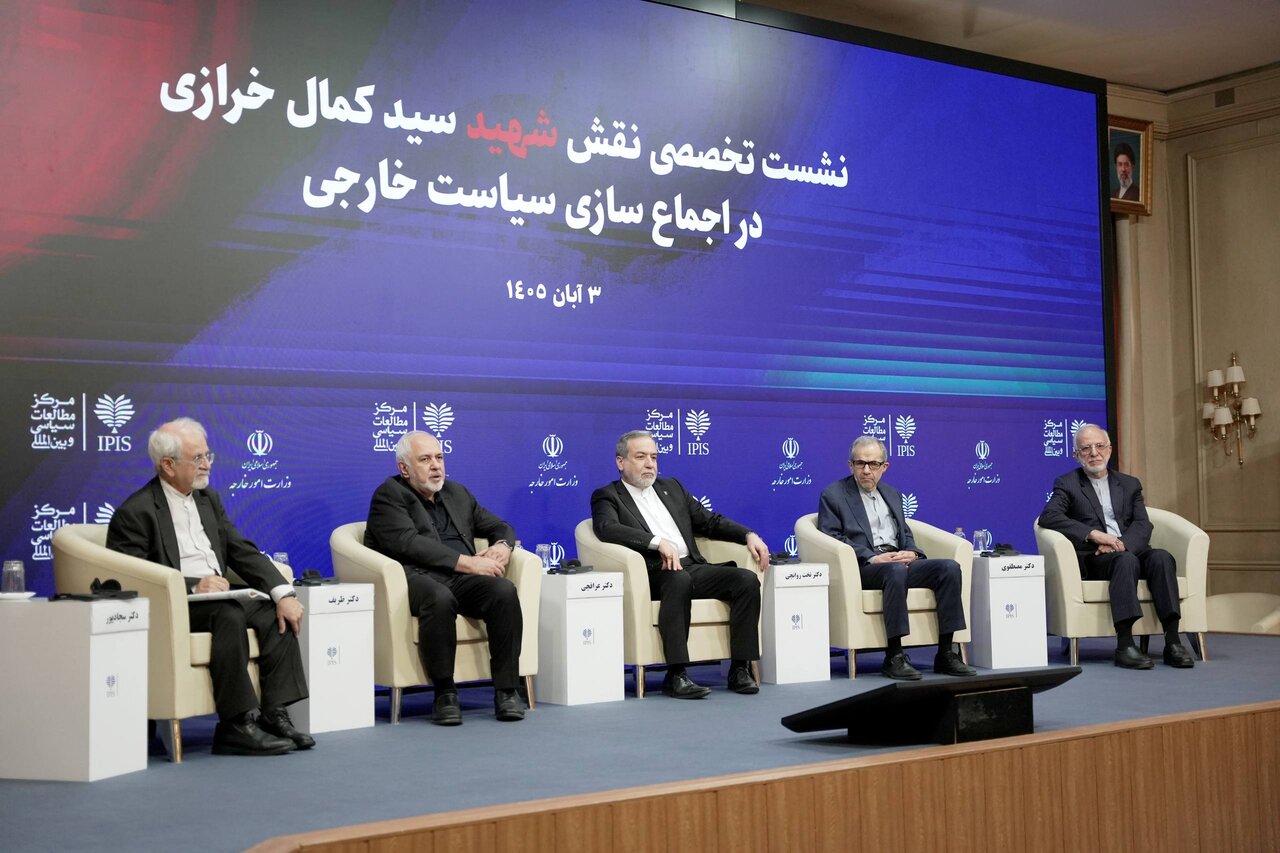

Mohammad Javad Zarif, the former foreign minister, described rationality, composure, devoutness and respect for the rights of others (haqq al-nas) as among the outstanding traits of Martyr Seyed Kamal Kharrazi and emphasized that humanity and devoutness held a special place in the personality of this distinguished diplomat.
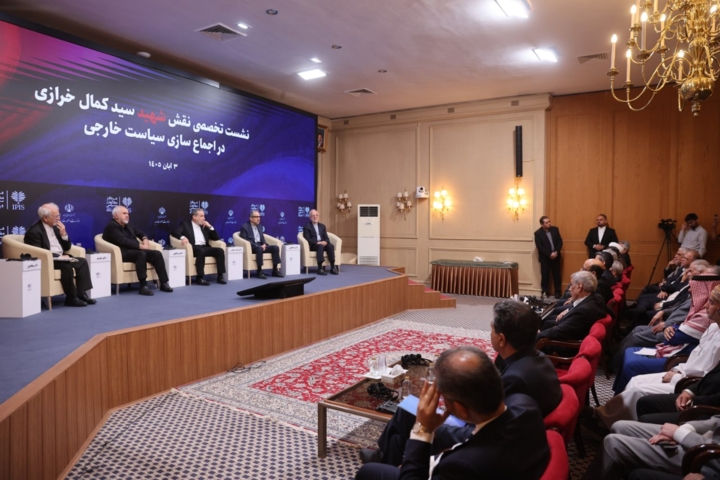
According to KhabarOnline, the specialized panel 'The Role of Martyr Kharrazi in Building Consensus in Foreign Policy' began on Sunday, October 25, at the Center for Political and International Studies of the Ministry of Foreign Affairs, with the presence of Seyed Abbas Araghchi, the foreign minister; Majid Takht Ravanchi, the political deputy of the foreign minister; Mohammad Javad Zarif, the former foreign minister; Mohammad Kazem Sajjadpour, professor at the Faculty of International Relations; Mehdi Mostafavi, former diplomat; and a number of other diplomats, officials and authorities, and the speakers explained and elucidated the role of Martyr Kharrazi, the former foreign minister and late secretary of the Strategic Council for Foreign Relations, in Iran's foreign policy.
Zarif: Martyr Dr. Kharrazi Was, in the Full Sense of the Word, a Human Being
As IRNA reports; 'Mohammad Javad Zarif,' the former foreign minister, said at this specialized panel: In my view, the most important trait of Martyr Kharrazi was his humanity. Being human is a difficult task, and Martyr Dr. Kharrazi was, in the full sense of the word, a human being. His composure was exemplary. He was rarely seen to lose his temper. Unlike me, who may become angry sooner, he, despite his seriousness, was always calm and composed and preserved his courtesy even in difficult circumstances.
He continued: Dr. Kharrazi's courtesy and respect in dealing with all people, from ordinary people and colleagues to employees and foreign parties, was completely evident. I had the honor of cooperating with him in periods in New York and Tehran, and in that time I never saw anything from him but composure, courtesy and mutual respect, whether in dealing with Iranian colleagues or in interaction with foreign parties.
Devoutness and Respect for the Rights of Others Were among the Outstanding Traits of Martyr Kharrazi
The former foreign minister continued: What my dear brother, Dr. Araghchi, put forward about the rationality and moderation of Martyr Dr. Kharrazi is completely correct. Throughout the time we were in contact with him, whether inside the Ministry of Foreign Affairs or outside it, and held him in affection, rationality always governed his conduct; this trait was clearly visible even in personal relations. But allow me to bring my remarks to a close with this point, that Dr. Kharrazi was a devout man. In all his conduct, he kept in view the pleasure of God, respect for the rights of others and respect for the rights of the people. This trait was evident even in his testaments; among them, the concern he had about the burial place of his esteemed wife, the martyred Mrs. Raeis Ghasem, and the emphasis that she be buried in an ordinary plot, not in the special sections.
Zarif noted: In my belief, the humanity and devoutness of Martyr Dr. Kharrazi surpassed his other outstanding personality traits; although all these traits were prominent in him. May his memory be honored and may his path remain enduring.
Martyr Kharrazi Made No Decision without Consultation and Review
Martyr Dr. Kharrazi was very much a person of consultation and of listening to the views of others. One of our problems is that we speak a lot and listen less; but Dr. Kharrazi was always a good listener and, more than speaking, listened to the words of others.
For this reason, the policies he pursued were very well-calculated. Mr. Mostafavi also rightly pointed out that Martyr Kharrazi did nothing uncalculated; because before every decision and every word, he consulted many times and engaged in conversation with his friends and colleagues.
During the Iran-Iraq war and after its end, when the negotiations had just begun, Martyr Kharrazi entered New York. At that time, we were pursuing two negotiation tracks: one track, the negotiations concerning Resolution 598, which were followed through the Secretary-General of the United Nations; the other track, the bilateral negotiations of Iran and Iraq, which were conducted through the permanent missions of the two countries in Geneva. In these negotiations, our dear colleague and friend, Mr. Sirous Nasseri, was present on behalf of Iran, and Barzan Tikriti, Saddam Hussein's brother, on behalf of Iraq.
It was very important for us that direct negotiations with Iraq should not cause the role of the United Nations to fade. Martyr Kharrazi too had a special sensitivity on this matter. I remember that in August 1990, at the same time as Iraq's attack on Kuwait, Dr. Kharrazi and I went to the island of Gotland in Sweden. Mr. Jan Eliasson, the special representative of the UN Secretary-General for the Iran-Iraq war, had gone to this island for a holiday. At Martyr Kharrazi's insistence, we went there to put the UN officials in the picture regarding the bilateral negotiations and to make sure that the United Nations would not be set aside from the process of addressing the Iran-Iraq war file.
The negotiations continued on their course, and the United Nations also played an important role in ending the war, ending the occupation of Iran's territory and freeing the Iranian prisoners of war. An important part of these matters was pursued through the bilateral negotiations and reached a result.
Martyr Kharrazi always emphasized preserving the role of the United Nations. One of the files on which I had the honor of close cooperation with him was the implementation of paragraph 6 of UN Security Council Resolution 598; a matter that concerned the difficult negotiations with the United Nations about identifying Saddam as responsible for starting the war.
These negotiations had many ups and downs, but Martyr Kharrazi pursued them with his exemplary calm and composure. His direct efforts, the cooperation and support of Ayatollah Hashemi Rafsanjani, and the positive view of the martyred Leader of the Revolution ultimately helped the country achieve an important victory in this field. The reality was that many in the world considered Saddam Hussein the initiator of the aggression against Iran, but the United Nations had not, until that time, officially admitted this reality. Pursuing this file and achieving a result in it counted as an important achievement for the Islamic Republic of Iran.
Martyr Kharrazi Attached Great Importance to the History of the Country's Diplomatic and Foreign Relations
My last recollection of Martyr Dr. Kharrazi also concerns this matter. Usually, on weekends, whether during my ministry or after it, whenever he had a matter he would invite me and I would go to his home; unfortunately, the same home in which he was martyred.
In our last meeting, he gave me a number of papers that were my own notes from the negotiations with the United Nations about the implementation of paragraph 6 of Resolution 598. At that time, the negotiations were very serious, and the notes I had taken concerned the meetings and conversations at which I myself had been present. Martyr Kharrazi asked me to go to his home and read these notes for him, because my handwriting was such that reading it was difficult. I did go and read the notes for him.
This recollection shows what a valuable step Dr. Araghchi has taken in naming the Center for Documents of the Ministry of Foreign Affairs after Martyr Kharrazi. Dr. Kharrazi attached great importance to the history of the country's diplomatic relations and foreign relations. Dr. Assefi and Dr. Ahani also know how many books and works he wrote about the memoirs of his period of ministry and ambassadorship; perhaps 10 to 12 volumes.
He was also in the process of compiling the memoirs of his ambassadorship period, and he would ask me for these notes so that they would remain in the records of the Ministry of Foreign Affairs. His goal was not merely the public publication of these materials; rather, he wanted these valuable memoirs to be registered and preserved in the documents of the Ministry of Foreign Affairs.
For this reason, the step of Dr. Araghchi and Dr. Khatibzadeh in naming the Center for Documents of the Ministry of Foreign Affairs after Martyr Kharrazi is a very valuable step. Here I must also remember our dear brother, Mr. Sadegh Kharrazi; he played an important role in the formation of this center. Martyr Kharrazi was among the founders of the Center for Documents, and he himself attached great value to documents and the history of diplomacy.
The noteworthy point is that even about two weeks before his martyrdom, he was still busy correcting and completing those same notes and memoirs of his ambassadorship period, so that these valuable and instructive materials would be prepared for the young diplomats of our country. Once again, I ask God to grant him exalted degrees, and I hope that we too can follow his path and manner and have a good end like him.
Araghchi: Martyr Kharrazi Had a Special Sensitivity and Precision in Spending the Public Treasury (Beit al-Mal)
Seyed Abbas Araghchi, the foreign minister, at the specialized panel 'The Role of Martyr Kharrazi in Building Consensus in Foreign Policy,' said: Dr. Zarif also rightly added the trait of humanity to the personality traits of Martyr Dr. Kharrazi. In the three years that I worked with him directly and every day at the Strategic Council for Foreign Relations, I observed and felt these traits up close. His commitment to the beliefs he held was completely evident.
He continued: Another of his traits that was very interesting for me was his scrupulousness and sensitivity regarding financial matters and the preservation of the public treasury. He would not allow unnecessary expenditures to take place, and he exercised special supervision and precision over all the expenditures of the council, so that not even a negligible amount of the budget would be spent pointlessly or where it should not be. In his own words, money that belongs to the public treasury must not be consumed elsewhere.
The head of the diplomatic apparatus then noted: The people present at this session will certainly testify to how sensitive, precise and responsible Martyr Kharrazi was in the financial matters of the Strategic Council for Foreign Relations. In my view, the same precision and sensitivity that he had in foreign policy matters also existed in all the affairs of his personal and working life. This was a distinguished trait of which, unfortunately, these days an example can rarely be found in other people; that a person, in all fields, whether in personal life or in matters related to work and professional responsibilities, should be this scrupulous and precise.
Takht Ravanchi: Sincerity, Devoutness and Love of Iran Were among the Enduring Traits of Martyr Kharrazi
'Majid Takht Ravanchi,' the political deputy of the foreign minister, at the specialized panel 'The Role of Martyr Kharrazi in Building Consensus in Foreign Policy,' said: I served him for several years in New York, and for several years in Tehran I worked as his assistant. After that too, my working and personal connection with him continued constantly. When Dr. Kharrazi went to New York, he was about 47 or 48 years old, and at the time of his martyrdom he was 81 years old. In all these years, from the years of youth to the end of his life, traits always remained constant in his personality, the most important of which were sincerity, devoutness and love of Iran. The friends who have worked closely with Martyr Dr. Kharrazi can confirm this matter.
He continued: While having a deep adherence to religious and faith beliefs, he had an outstanding love of Iran. Martyr Kharrazi grew up in a traditional and religious family and studied at the Alavi School, and for this reason he was intimate with Islamic teachings and Islamic ethics and conduct. At the same time, it was very important for him that the name of Iran be raised at the highest international levels and that our country have a worthy standing in the world.
The deputy foreign minister noted: As Dr. Araghchi also mentioned, Martyr Kharrazi was a distinguished, believing and Iran-loving diplomat who was concerned for Iran and for the credit of the country's name. Here I also wish to remember his wife, who in all these years was his companion and supporter. If we look at Martyr Kharrazi's record from the early years of the revolution, his various responsibilities during the imposed war and after it, his presence in New York and his activity in the Strategic Council for Foreign Relations, part of his successes and services to the country must be owed to the companionship and support of his wife. His wife too was a very noble and kind human being. Both of those great ones were noble and valuable human beings who in the end attained martyrdom.
Sajjadpour: Martyr Kharrazi Preserved the Spirit of Teaching and the Love of Education until the End of His Life
Mohammad Kazem Sajjadpour, professor at the Faculty of International Relations of the Ministry of Foreign Affairs, at the specialized panel 'The Role of Martyr Kharrazi in Building Consensus in Foreign Policy,' said: Martyr Dr. Kharrazi was a first-class teacher; of course, he was also a university professor, but his outstanding trait was that he looked at every opportunity as an opportunity for education, upbringing and learning. I remember that when in New York discussions were being held about his return, he would say: 'New York is a university, and we must provide this opportunity for everyone to go there and learn.' This view shows his belief in continuous learning and in encouraging others to acquire knowledge.
He continued: I think the point with reference to which I can bring my remarks to a close is this very deep love of his for education. Whenever we raised the discussion of education, especially given his background at the Alavi School, I felt that he entered the discussion with greater passion and enthusiasm, as if he were stepping into another world. This constant love of knowledge, teaching and instruction existed in him until the end of his life. The establishment of one of the important research centers in the field of cognitive sciences is, in my view, an example of this very outstanding trait. Martyr Kharrazi, until the last stages of his life, preserved the spirit of teaching and the concern for education and learning.
Source: KhabarOnline
Related stories
Displaced People's Tents in Gaza Set on Fire in the Zionist Regime's Attacks
Diplomacy Driven by Oil