First Hormuz, Then the Nuclear File
Based on the published details of the European troika's proposal, this plan rests on separating the crisis into two stages. In the first stage, a temporary agreement takes shape over the Strait of Hormuz and the blockade, and then the path is paved for negotiating a more comprehensive agreement, including the nuclear file, sanctions and frozen assets. The 2015 nuclear agreement is also, according to reports, one of the reference bases in this path. The logic of this approach is that instead of trying to resolve all disputes in a single package, first an urgent and costly knot is untied and, after tensions decrease, the more complex negotiations continue. The Strait of Hormuz, because of its place in energy transit and the effect of disruption in it on the global economy, is an expectable starting point for such an initiative. Nevertheless, until the official details of the plan and the final positions of Tehran and Washington become clear, this proposal should not be confused with an accepted agreement. The positions of Saeed Khatibzadeh, Iran's Deputy Foreign Minister, show that Tehran does not look only at the content of the European proposals, but also considers the behavior and credibility of the mediators part of the equation. Criticizing Europe's approach toward regional developments, he has emphasized that European countries, in order to play an effective role, must distance themselves from supporting the actions of America and Israel, not allow their bases to be placed at the disposal of American operations, and adopt a practical and honest approach to revive international collective achievements. Expressing doubt about a change in Europe's approach, Khatibzadeh has effectively raised this question: can the European countries, beyond presenting a plan, provide a credible guarantee for its implementation?
This position clarifies the main challenge of the fresh initiative: Europe wants to have a role once again in the process of resolving the crisis, but to be influential it must show that it is not merely the carrier of a new proposal and also has the ability to influence Washington's decision. The experience of the JCPOA and America's withdrawal from it still casts a shadow over Tehran's calculations; a political agreement gains practical value when the parties' commitments are reliable and implementable. The simultaneity of diplomatic movements with concerns about the energy market raises an important question: as the economic cost of the crisis increases, does the parties' incentive to negotiate also increase? Disruption in the Strait of Hormuz can raise transportation and insurance costs and put pressure on the global energy market — consequences that are not limited to the countries of the region and are transferred to farther economies as well. This very link between regional security and the global economy gives mediators an incentive to find a way to contain the crisis before it expands. Of course, the simultaneity of rising oil prices and the activation of mediators does not by itself prove that these movements are merely a reaction to the market. Nevertheless, the more costly the crisis becomes, the more the cost of diplomacy's failure increases for more parties as well. Oil in this equation is not just an economic indicator; it is a factor that highlights the political urgency of resolving the crisis. The question is whether this pressure leads to real flexibility at the negotiating table or merely launches a wave of fresh plans that ultimately remain fruitless.
Why Is the Seven-Day Initiative Not the Priority?
Meanwhile, Iran's seven-day initiative has special importance. Tehran has announced that it has transferred its proposal through mediators to the American side and has also received Washington's initial response. Based on Iranian officials' explanations about this initiative, the reopening of the Strait of Hormuz and the start of the path to a final agreement are tied to actions by America, including in connection with the blockade and the end of the clashes. Nevertheless, the dispute over the order of actions and the scope of commitments remains in place. The main difference between Iran's initiative and Europe's reported plan is in the order of steps and the expected guarantees. Tehran wants specific actions to be taken by Washington before taking some steps; in contrast, the European plan tries, with a temporary agreement over Hormuz and the blockade, to open the way to broader negotiations. Therefore, the issue is not only the presentation of a new proposal, but also which side must act first and what mechanism will prevent a repetition of the experience of the failure of previous agreements. If Washington's immediate goal is to reduce tension and return shipping to stable conditions, it is expected that instead of piling up plans, it clarifies its position on the existing initiative: which clauses are unacceptable and what practical alternative is proposed for it? Europe's plan can help advance dialogue, but it should not become an excuse for ignoring proposals that have previously been placed on the table.
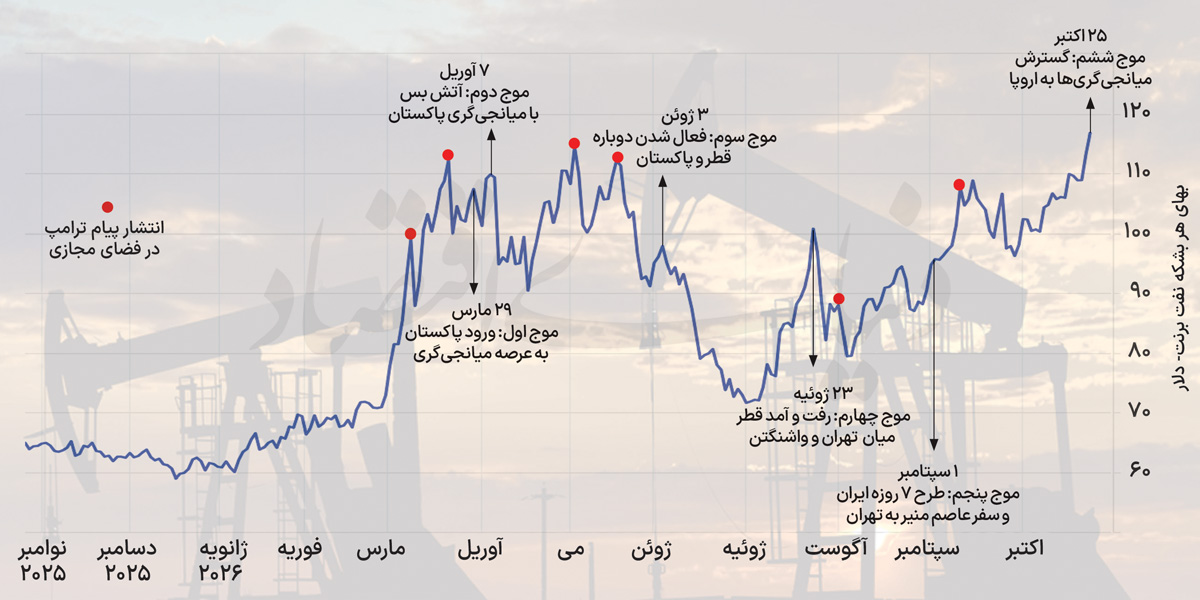
When Did Oil Rise and When Did the Mediators Become Active?
First wave: March 29 / Oil jumps; Pakistan enters the field
Following the escalation of the war and disruption in Strait of Hormuz transit, the price of Brent rose from about 77 dollars on March 2 to about 127 dollars on March 31. On March 29, Pakistan hosted negotiations attended by Turkey, Egypt and Saudi Arabia, to find a way to end the war and reopen the shipping route. This is the first clear example in the period under review in which an oil jump and the expansion of regional mediation are seen simultaneously.
Second wave: April 7-8 / Oil reaches its peak; Pakistan's mediation leads to a ceasefire
Brent reached about 138 dollars on April 7, which is the highest level recorded in this period. The next day, Pakistan's intensive effort led to the announcement of a temporary ceasefire. Islamabad, in the final hours, contacted American and Iranian officials and, alongside that, conveyed messages about containing Israel's attacks as well. This is the strongest starting point, where market pressure and the danger of the war's expansion bring diplomacy and mediation into play intensively. Of course, the military threat and Trump's deadline were also among the direct factors of the ceasefire.
Third wave: June 3 to July 2 / Efforts to preserve the ceasefire; Qatar and Pakistan return to the negotiations
Brent again passed 100 dollars on June 3 and reached about 102 dollars. After the June temporary understanding, Qatar and Pakistan advanced the negotiation mechanism; on June 22 a high-level meeting was held in Switzerland, and on July 1 the indirect negotiations continued in Doha. After signs of progress in the talks and an improvement in the flow of tankers, prices decreased. This stage has special importance for the report: the market was reacting not only to the start of negotiations, but also to the probability of Hormuz reopening and a real increase in oil supply.
Fourth wave: July 23 to August / Renewed increase in supply risk; Qatar's return to Tehran
After the violation of the temporary agreement on July 23, spot Brent reached about 105 dollars. On July 29, after several days of sporadic attacks on the coastal strip, news came of an agreement to dispatch negotiating delegations to Qatar. In early August, efforts continued for a broader agreement over Hormuz. Then, on August 27, Qatar's prime minister traveled to Tehran to revive the mediation; on August 28 as well, reports spoke of intensified efforts to reopen the strait. After the failure of the previous understanding, mediation became active again not as a continuous process, but in reaction to the danger of the crisis escalating and shipping being disrupted.
Fifth wave: September 15-30 / A fresh peak in prices and Iran's seven-day plan
Spot Brent reached about 131 dollars on September 15. Iran raised its seven-day proposal for reopening Hormuz in mid-September. On September 25, Iran's foreign minister said that if Tehran's conditions are met, there is a possibility of reopening the strait at the end of seven days. On Monday, September 28, after the proposal was rejected by Trump, the oil price jumped by more than four dollars in early trading; the same day, Qatari mediators entered into action to talk with the two sides. On September 30 as well, news arrived that America's response had been transferred to Tehran via Qatar. This case is very important in terms of timing: the rejection of Iran's proposal was accompanied by a jump in the oil price, and Qatar's mediation immediately became the focus of the news. This is the closest example to the hypothesis of diplomacy driven by oil.
Sixth wave: October 20-25 / Oil at a multi-month peak; mediation expands to Europe
On October 20, Brent reached its highest five-month level and closed the day at 108.79 dollars. At the same time, Iran's president spoke with Pakistan's army commander about mediation, and reports were published of a fresh plan being presented by Qatar and Pakistan. On October 21 as well, after hopes for diplomatic progress dimmed, the Brent price rose again by more than two dollars and reached 117 dollars, the level of prices in March. On October 23, the foreign ministers of Britain, France and Germany, together with Turkey, Saudi Arabia, Pakistan, Egypt and Italy, consulted in Istanbul about Hormuz and the necessity of preventing a fresh attack on Iran; France's foreign minister explicitly warned that an escalation of the crisis would have serious consequences for hydrocarbon prices. On October 25 as well, the European troika entered the mediation story with a two-stage plan, and at the same time Qatar and Pakistan's efforts in this path continue.
Source: Donya-e-Eqtesad