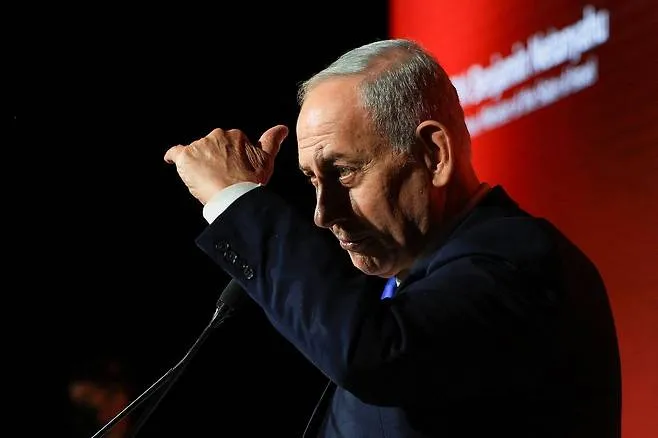
Entekhab News (Entekhab.ir): Nadav Eyal, a journalist for Yedioth Ahronoth, wrote that Benjamin Netanyahu received the latest set of polls last night, which show that the Likud party and his political bloc are rapidly weakening.
According to 'Entekhab', the article continues: Then came his remarks regarding the Israeli economy; remarks that, throughout his long political career, are considered among his rarest statements. Regardless of the goal Netanyahu pursued in making these statements, his words have real and significant consequences for the Israeli economy, whether before Tuesday's election or after it, regardless of who forms the next government.
In an interview with Israeli journalist Roy Katz, broadcast on Friday, the Israeli Prime Minister said that US military assistance to Israel is coming to an end. He stated: 'This matter is finished; it is only a matter of time.' Netanyahu added that Israelis must accustom themselves to the reality that they will no longer receive tens of billions of dollars in defense aid from the US, 'because America has changed.'
This remark alone is significant. In Israel, the realization is gradually taking shape that US military assistance in its current form must inevitably change and may even come to an end, especially as bipartisan support for Israel in Washington is declining.
Netanyahu himself had previously spoken of his desire to gradually reduce Israel's dependence on this aid. However, there is a wide gap between accepting this reality and having the incumbent Prime Minister practically announce the end of one of the pillars of the US-Israel strategic relationship.
The current memorandum of understanding between the two countries, under which the US allocates $38 billion in aid to Israel over a ten-year period, is valid until September 2028. This agreement is rooted in a network of mutual interests of which the US defense industry is a part.
Israeli diplomats in Washington are working hard to preserve this agreement, and Israel's friends in the US Congress continue to fight to preserve the special relationship between the two countries, despite a more difficult political climate.
When the Prime Minister of Israel himself says 'this matter is finished,' such a message is very heavy and alarming for Israel's defense establishment and for those in Washington who are still striving to help the country.
But this was only the beginning of the story. Netanyahu said: 'Sanctions may be imposed, including banking sanctions.' He explained that Israel must prepare an economy capable of circumventing these sanctions.
This issue is on an entirely different level of importance. To understand the matter, several points must be considered. In the world of international sanctions, sweeping banking sanctions against a country are among the most powerful tools major powers possess.
These sanctions are neither import restrictions, consumer boycotts, nor even arms embargoes. Extensive financial sanctions directly target the circulatory system of a country's economy.
Israeli banks depend on the global financial system, including correspondent banks, clearing mechanisms, credit lines, and the ability to transfer money across borders. Without access to foreign banks, the Israeli economy grinds to a halt.
These sanctions do not target only banks; they affect everyone who works with them, from corporations, exporters, and importers to investors and employers.
When foreign banks become concerned about a country's financial institutions, they typically restrict or sever their relations far beyond what the law requires.
In other words, the implementation of a comprehensive financial sanctions regime pushes Israel toward a situation similar to what Iran and Russia face.
Of course, Israel's conditions could be even worse. Iran and Russia possess massive oil and gas reserves. These two countries continue to sell their energy resources even under sanctions, mostly in Asia and parts of the Global South.
However, Israel's economy is not built on the export of raw materials and commodities. The power of this economy stems from integration into the global economy, human capital, technology, research, and advanced services.
According to the Israel Innovation Authority, the country's high-tech sector exported about $85 billion in goods and services in 2025, accounting for 58 percent of Israel's total exports.
This sector also accounted for about half of the country's economic growth. High-tech is the driving engine of the Israeli economy, and its performance depends on foreign markets, foreign capital, and the free flow of money.
Netanyahu did not specify which country might impose banking sanctions against Israel. When a country's Prime Minister raises such a possibility while simultaneously speaking of the end of US aid, serious questions must be raised immediately.
Does he mean European sanctions? US sanctions? And most importantly, how has Israel reached a point where such a possibility is even raised in its political circles?
But the story did not end there; other parts of his remarks were even more alarming. Netanyahu said: 'You must organize a circumventing economy.'
In explaining this idea, he pointed to digital currencies. When asked whether blockchain technology could be a substitute for the conventional financial system, he replied: Yes. He said: 'It is an option. Definitely. I have previously ordered a plan to be prepared for this.'
An economy designed to circumvent sanctions is a survival strategy for countries cut off from large parts of the international system, countries like Cuba. Iran has also created such a structure, relying on shell companies, alternative payment channels, and networks for transferring money and goods outside official and transparent mechanisms. Russia has followed a similar path.
The cost of this approach has been heavy: impoverishment and long-term isolation.
The cryptocurrency part also requires special scrutiny. Digital currencies can indeed facilitate the transfer of value outside some traditional banking channels. But they cannot replace a national financial system.
Cryptocurrencies cannot provide bank credit lines, replace international capital markets, or convince foreign companies to violate sanctions prohibiting economic activity with Israel. Cryptocurrency transactions themselves are subject to monitoring, restrictions, and the enforcement of sanctions regulations.
Israel's cryptocurrency industry quickly reacted to these statements, emphasizing that public blockchains are transparent and traceable and cannot be used as a haven for hiding money. Industry activists do not want to be associated with Netanyahu's vision for circumventing sanctions.
Netanyahu did not merely mention the possibility of sanctions; he spoke of preparing a sanctions-circumventing economy and announced that he had previously ordered a plan to be prepared in this regard.
He made these remarks in a calm tone in response to direct questions, presenting the issue as a probable scenario whose preparation and expert review are necessary.
Such statements, even before any sanctions are imposed or a vote is cast, can alarm and destabilize markets, investors, and financial institutions.
About a year ago, Netanyahu said Israel must become a 'super Sparta,' adopting more self-reliant economic characteristics close to an autarky.
At the time, those words could be interpreted as a call for greater independence in producing defense equipment. But now Netanyahu is explicitly talking about banking sanctions and creating an economy to bypass sanctions.
Here, two possibilities exist. First, Netanyahu truly believes what he is saying and takes this scenario seriously. In that case, he is warning Israelis that the economy faces a threat never before encountered on such a scale, because without the high-tech sector and a properly functioning economy, neither society can function normally nor can a modern army continue its operations.
If so, the public has the right to know on what basis this assessment was made and where the ideas regarding a 'sanctions-circumventing economy' and the use of cryptocurrencies came from.
The second possibility is that Netanyahu spoke without sufficient preparation and review about a matter whose dimensions he has not yet fully examined. Such a possibility also raises serious questions about his judgment and ability to continue serving as Prime Minister.
Reactions among economic activists and Israel's high-tech community have been very harsh. Investors, business owners, company founders, and other figures in this field view Netanyahu's remarks as a sign of a deep loss of control and poor judgment.
Will these statements impact the elections? It appears that after the conclusion of Shabbat in Israel, Netanyahu will attempt to explain his remarks and clarify what he meant, and then likely try to direct public attention toward another topic.
Source: Entekhab