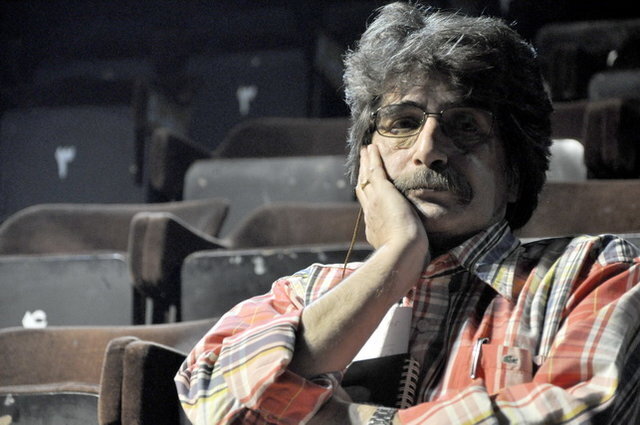
Mehr News Agency - Arts Desk - Ali Heidari; For its artists in Iran, theatre has always been a great word; in a sociological view, theatre artists have a different spirit and characteristics from other artists, and this is why some are addressed as "theatre people." Perhaps, in analytical terms, no linguistic study has been done on the word "theatre person," but if we look carefully at the lives of the artists who are placed in this category, we find components, the most important of which is living in the world of theatre. It is as though some of the people of this art go mad from a certain point on, and nothing but the stage and the light consoles this madness.
Today is October 25, and in the calendar of theatre people it is considered an important day. Today, someone was born who was truly mad and enamored of words and stages. He lived theatre in the absolute sense of the word, and until the last days of his life he was in love with and dependent on theatre. October 25 is the birthday of Mahmoud OstadMohammad, playwright, director and actor; someone who in his life lived among stages and stories, and whose departure darkened a stage of the lives of many of his admirers.
Leafing Through a Record; Jam Hospital Became the Final Stage of the Creator of "The Twenty-First Night"
OstadMohammad wrote and staged numerous works during his 62-year life. Among the prominent works of this late artist, mention can be made of "The Twenty-First Night," "Divan-e Theatral," "Family Photo," "The Last Play," "A Seyyed Kazem," "Sormeh" and more. All of these works, during his lifetime and after it, have been staged many times by different people, and he, without any expectation, offered enthusiasts the permit to perform his works. He even sat and watched those works during his own lifetime and was delighted and excited by this watching. This tradition was continued after him by the daughter of this artist, Mana OstadMohammad, and she, like her father, offers applicants the permit to perform OstadMohammad's works without any expectation.
OstadMohammad, despite his multilayered life and existence, was like a child who becomes delighted at seeing beauty, and the existing quotes from people who encountered him put a seal of confirmation on this matter. Beyond all the characteristics of OstadMohammad that have made him an enduring figure in the history of Iranian theatre, the manner of his training of his students, who are still present in our theatre and are active, is an interesting subject. He continues his life by training numerous students, in all of whom loyalty to theatre is very pronounced.
A Pen That Was the Voice of the People of the Lower City
OstadMohammad's works have linguistic characteristics and components; in his plays he constantly speaks of people who have no voice in society, those who under the pressure of poverty become thinner and weaker day by day. OstadMohammad is the representative of the people of the lower city; he states the pain and problems of this stratum in a frank and explicit language, and it is for this reason that OstadMohammad can be considered among the most important playwrights, who are very capable in creating social works. In most of his works a social problem has been reflected, some of these problems from the depth of his lived experiences and some others from his precise observations of the hidden layers of society. OstadMohammad was, in the true sense of the word, "concerned," and his concerns never had a personal aspect; he constantly, in his works, was the voice of a part of society. A number of OstadMohammad's works are placed in the category of coffeehouse plays, which are of great importance in line with producing words and creating added value in our playwriting language.
An Author Who Was Suffering
In the films and documentaries that remain of OstadMohammad, his suffering and madness for theatre are very tangible. He is immersed in the world of stages, and it is as if, with the utterance of the name OstadMohammad, theatre is what becomes manifest. Even when cancer had taken OstadMohammad's body into its possession, he, at the sidelines of a ceremony, with the help of a few people, appeared on stage and from behind the podium spoke of his concerns about theatre.
In part of this short speech he stated: "Some people do not understand how important theatre is to us and how much we have worked for it." In another documentary, he speaks of the process of writing "The Twenty-First Night" and states that he is afraid of reading his own play and is astonished at how he committed such a bitter work to writing. Only a few days before his death in July 2013, he came to the City Theatre to meet once again with this Kaaba of the aspirations of theatre people. Perhaps he himself knew that this was the last meeting, and that fate would not grant him respite to see theatre or make theatre at the City Theatre again.
The Theatre That Returned Home Once More After His Death; The City Theatre No Longer Has OstadMohammad!
On July 25, 2013, OstadMohammad, due to liver cancer, closed his eyes to the world at Jam Hospital, and from that day on, our theatre did not have a "Qalandar," and with the flight of his soul an emptiness remained that may torment his admirers forever. If you stop by the third floor of the City Theatre complex, you will see the poster of "Divan-e Theatral," written and directed by OstadMohammad, nailed to the wall, as if OstadMohammad is still present in his home, the City Theatre, and his deep footprint can be seen in every corner of this place.
Perhaps it would not be amiss to end this article with a sentence from another of OstadMohammad's interviews. In an interview he said: "I wish theatre were a good land for living. I wish those who entered this valley, their entrance was accompanied by happiness, which it is not."
Finally, after OstadMohammad's passing, his body came once more to the City Theatre, but this time there was no soul in the body, and from there he was escorted toward his eternal home, the Artists' Section of Behesht-e Zahra.
The film of part of this late artist's talks about theatre is attached to the report.
Source: Mehr News Agency