Amir-Mehdi Naderi: Russia's October Revolution of 1917 was not just a transfer of power in Petrograd; it was the moment when the exhaustion of the Tsarist empire, the failure of the Provisional Government, society's weariness of war, the hunger of the cities, the peasants' thirst for land and the revolutionary ambition of the Bolsheviks all came together at a single point. It was this very simultaneity that turned an event of a few days into one of the most influential transformations of the twentieth century; a transformation from which the Soviet Union, the Cold War, the model of the vanguard party, the modern ideological state and an important part of the political literature of the contemporary world emerged.
The October Revolution, according to the Julian calendar that was then common in Russia, took place on October 24 and 25, 1917 [2 and 3 Aban 1296], and the name 'October' remained attached to it and was fixed in the political memory of the world. In the official Soviet narrative, this revolution was the beginning of the liberation of the workers and peasants; in the view of the Bolsheviks' opponents, it was an organized coup that cut off the path of Russia's nascent democracy.
Revolutionary armed forces, after seizing the communications centers, railway stations and strategic points of the city, besieged the Winter Palace, the seat of Russia's Provisional Government. The firing of a blank shot from the cruiser 'Aurora' became one of the most famous symbols of this event; an event that led to the fall of the Provisional Government and the transfer of power to the Bolsheviks.
What took place in the streets of Petrograd was, compared with its far-reaching consequences, a relatively short operation. But seizing power in the capital marked the start of a long and bloody process to consolidate the new government; a process that brought in its wake civil war, economic crisis, the suppression of opponents and the rebuilding of Russia's political and social structure.
Russia on the Verge of Explosion; an Empire Gripped by War and Crisis
To understand the October Revolution, one must go back to the conditions of Russia in the final years of the rule of the Romanov dynasty ; a dynasty that had ruled over a large part of Eurasia for more than three centuries.
At the beginning of the twentieth century, Russia, despite its territorial expanse and considerable military power, suffered from deep economic and social problems. A large part of the country's population consisted of peasants who demanded reform of the land-ownership system. In the industrial cities too, workers faced difficult working and living conditions, low wages and restrictions on political activity.
Russia's entry into the First World War in 1914 intensified these problems. Military defeats, heavy human losses, disruption in transport and food shortages weakened the capacity of the government of Nicholas II to administer the country.
Lewis Siegelbaum, a historian of Soviet Russia, explains in the article 'The February Revolution' that the protests leading to the fall of the Tsarist government began from economic discontent and bread shortages and, with the soldiers joining the protesting workers, turned into a political crisis.
On February 23, 1917, by the old calendar, equal to March 8, the women workers of Petrograd came into the streets in protest at high prices and food shortages. These protests gradually spread, and parts of the army that had been tasked with suppressing the demonstrators joined the protesters.
In the end, Nicholas II, on March 2 by the old calendar, equal to March 15, 1917 [24 Esfand 1295], abdicated the throne, and the centuries-old rule of the Romanovs came to an end.
But the fall of the Tsar did not mean the end of Russia's crisis. A country that suffered from war, poverty and instability now faced a fundamental question: who should take power into their hands, and how should the Russia of the future be administered?
The Provisional Government, which was formed after the February Revolution, was supposed to administer the country until the Constituent Assembly was formed. This government was not elected, and many people considered it a softer continuation of the power of society's upper classes. Alongside the Provisional Government, the Petrograd Soviet also took shape; an institution resting on the representatives of workers and soldiers that very soon became the real center of social influence. Siegelbaum explains in the article 'The Formation of the Soviets' that the Petrograd Soviet was at first mostly in the hands of the Mensheviks and the Socialist Revolutionaries, and that its leaders' initial aim was not the complete seizure of power but the defense of the achievements of the February Revolution.
In this way, Russia entered a phase known in historical literature as 'dual power': on one side the Provisional Government, with its claim of formally administering the country; on the other side the Soviets, with the backing of workers, soldiers and parts of urban society. This duality was inherently unstable, because neither of the two centers of power had the ability or the will to eliminate the other, yet both wanted to determine the path of Russia's future.
Two Issues the Provisional Government Could Not Solve
The Provisional Government, in the first months of its activity, expanded some political and civil freedoms. The restrictions on party activity were reduced, the press found a more open space, and new civil institutions were formed.
Nevertheless, the government remained unsuccessful in responding to two fundamental demands of society: ending the war and land reform. Russia had suffered heavy defeats in the First World War. The army was falling apart, the economy was exhausted and the cities were gripped by shortages of food and fuel. Even so, the Provisional Government decided to continue the war. One of the reasons for this decision was Russia's commitments to the Allies and the fear of Britain and France cutting off their support. But for the peasant soldier who was fighting at the front and whose family in the village awaited land, such reasoning was not convincing.
The land issue was no less critical than the war. The peasants demanded the immediate division of the large estates, but the Provisional Government announced that decision-making about land reform must be left to the Constituent Assembly. This response, while perhaps legally cautious, proved politically disastrous. The peasants did not wait; land seizures in rural areas increased, and peasant soldiers too were leaving the front so as not to be left behind in a possible division of lands.
The continuation of the war, the postponement of land reform, shortages of food and fuel, rising prices and the inability to meet the army's needs eroded the government's credibility and prepared the ground for the growth of the Bolsheviks. The Provisional Government could neither preserve the old order nor build a new order.
Lenin's Return and the Birth of a Policy in Three Words to Mobilize a Discontented Society
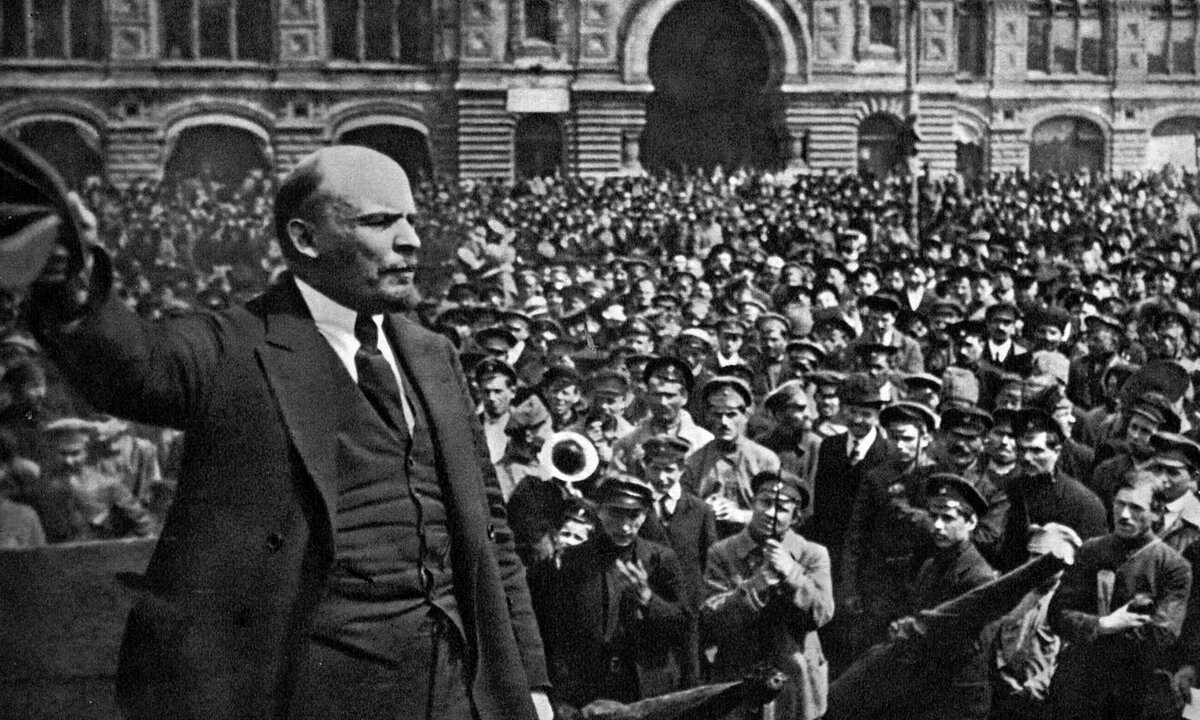
In April 1917, Vladimir Ilyich Lenin returned to Russia from exile in Switzerland. His return was a turning point in the course of the revolution. Lenin, unlike many of the moderate socialists, believed the revolution should not stop at the stage of forming a liberal government. He announced in the 'April Theses' that the Bolsheviks should not support the Provisional Government and should make the slogan 'All Power to the Soviets' the axis of their policy. He also gave a promise that was summed up in three words: 'Peace, Land and Bread.'
The importance of this slogan lay in the fact that it targeted precisely the three main crises of Russian society: peace for the soldiers and families worn out by the war; land for the peasants who formed the majority of Russia's population; and bread for the workers and citizens who stood in long food queues. With this same clear program, Lenin prepared the Bolsheviks to take power: first, control of the Petrograd Soviet, then the seizure of power in the name of the Soviet, and after that the repetition of this process in other cities. While the Mensheviks and the Socialist Revolutionaries supported conditional cooperation with the Provisional Government, Lenin insisted on the necessity of passing beyond this stage.
At first, many socialists considered Lenin's positions extremist. Even among the Bolsheviks there was disagreement about the possibility and the timing of seizing power. But the series of crises of 1917, one after another, strengthened Lenin's position. He had understood that the Provisional Government was incapable of responding to society's urgent needs, and that a party that could express these needs in simple language and with an effective political organization could become the determining force.
An Army That No Longer Wanted to Fight
One of the most important signs of the collapse of the government's authority was the state of the army. The army of imperial Russia at the time of the February Revolution had about seven and a half million soldiers, most of whom were peasants. Order No. 1 of the Petrograd Soviet, which demanded the formation of soldiers' committees and the recognition of soldiers' civil rights outside military service, transformed the traditional command structure of the army.
In the first weeks of the revolution, tens of thousands of soldiers fled the front. Many of them left the front not necessarily out of opposition to Russia, but to return to the village and be present for the division of lands. The Provisional Government tried to restore the army's morale with a new military attack. Alexander Kerensky, the minister of war and then prime minister, in June 1917 ordered an offensive against the forces of Austria and Germany. But this operation failed and produced the opposite result: the army's morale collapsed still further and urban protests intensified.
The failure of the June offensive paved the way for the 'July Days'; days when the soldiers, sailors and workers of Petrograd rose in armed protest. The Bolsheviks had a dual position toward this movement. On the one hand, parts of the party supported the protest; on the other hand, the party leadership was worried that a premature uprising would provide an excuse for repression. The Provisional Government suppressed the uprising; Trotsky and a number of Bolshevik leaders were detained and Lenin fled to Finland.
In appearance, the Bolsheviks had been defeated; but Russian politics in 1917 was so unstable that the July defeat very soon gave way to a fresh opportunity.
Kornilov; a Coup That Ended to the Bolsheviks' Benefit
In August 1917, General Lavr Kornilov, the commander-in-chief of the army, moved toward Petrograd. In the eyes of conservatives and some propertied classes, he could restore 'order' to the country. But for the Soviets, the workers and the Bolsheviks, Kornilov's move was a sign of the danger of counter-revolution. Kerensky, who himself stood at the head of the Provisional Government, was compelled, to defend the capital, to ask for help from the Petrograd Soviet and the leftist forces.
This event was a great turning point. The Red Guards, Bolshevik activists and railway workers had a role in stopping Kornilov's forces. The main winner of this crisis was the radical left, especially the Bolsheviks, for they had warned earlier about the danger of counter-revolution and could now present themselves as the defenders of the revolution.
After Kornilov's defeat, the credibility of Kerensky and the Provisional Government was severely damaged. The Bolsheviks, in September, gained a majority in the soviets of Petrograd and Moscow. Trotsky, who had been freed from prison, rose to the chairmanship of the Petrograd Soviet and then took charge of leading the Military Revolutionary Committee; a committee that, in the fateful days of October, was to play the role of the operational headquarters of the uprising.
Now the conditions were ready for a determining action.
The Fateful Night; How Did the Bolsheviks Gain Power?
On October 10, 1917 [18 Mehr 1296], Lenin returned from hiding and called the Central Committee of the Bolsheviks to an armed uprising. Some leaders, including Grigory Zinoviev and Lev Kamenev, opposed immediate action and considered it dangerous. But Lenin believed that delay would take the opportunity away from the Bolsheviks; especially since the elections to the Constituent Assembly were near and it was not clear that the Bolsheviks would gain a brilliant result in them.
On October 24 [October 24 (2 Aban)], by the old calendar, Kerensky's government tried to shut down the Bolshevik newspapers and increase the pressure on the Military Revolutionary Committee. This action provided the necessary excuse for the move. The Red Guards, soldiers supporting the Bolsheviks and the sailors of Kronstadt seized the key points of Petrograd: the railway stations, the bridges, the telephone center, the state bank and the power stations. Little serious resistance took place.
On the evening of October 25 [October 25 (3 Aban)], the operation to capture the Winter Palace began, and the Winter Palace, the seat of the remains of the Provisional Government, was placed under siege. The blank shot of the cruiser 'Aurora' became the symbol of the start of the final assault. In the end, the revolutionary forces entered the palace and detained the members of the Provisional Government. Kerensky had fled the capital earlier. The revolution in the capital, contrary to the later cinematic images, was in most places accompanied by limited violence and little resistance.
At the same time, the Second All-Russian Congress of Soviets was formed. The Bolsheviks announced that the Provisional Government had been overthrown and that power had been transferred to the Soviets. When the Menshevik representatives and part of the Socialist Revolutionaries left the session in protest, Trotsky, in a harsh tone, consigned them to the 'dustbin of history'; a phrase that became one of the most famous sentences of the Russian Revolution.
The First Decrees; Promises That Turned into Law
On October 26, 1917 [October 26 (4 Aban)], the Congress of Soviets entrusted power to the Council of People's Commissars. Lenin became the head of this council, Trotsky the commissar of foreign affairs and Stalin the commissar for nationality affairs. The new government, in its first step, issued two important decrees: the Decree on Peace and the Decree on Land. But carrying out revolutionary programs in a country gripped by war and economic crisis was much harder than putting forward political slogans.
The Decree on Peace demanded the start of negotiations to exit the war and to reach a 'just and democratic' peace. The Decree on Land abolished large landownership and handed lands over to the peasant committees. In this way, the slogan 'Peace, Bread and Land' rose from the level of street propaganda to the official policy of the new government. A little later, the banks were nationalized, workers' control over production was raised, and peace negotiations with Germany began in Brest-Litovsk; negotiations in which Trotsky, at one stage, held the leadership of the Russian delegation.
But the victory in Petrograd did not mean definite control of Russia. Moscow fell into the hands of the Bolsheviks only after a few days of clashes. Vast regions of Russia were either in a state of hesitation or had risen in opposition. Civil war, famine, foreign intervention and political violence were on the way. The Bolshevik government, to consolidate itself, founded the Cheka in December 1917; a security institution to confront counter-revolution and sabotage. The Constituent Assembly too, after being formed, was dissolved very soon; a move that showed the Bolsheviks took their legitimacy more from their own hand-made revolutionary party than from parliamentary elections.
The Brest-Litovsk Peace; the First Collision of the Ideal with Reality
One of the hardest decisions of the newly founded government was how to exit the First World War. Lenin believed that continuing the war could destroy the revolution. The Russian army was in an unsuitable state, and the new government needed peace to consolidate its power. In contrast, Trotsky and some other Bolshevik leaders hesitated to accept Germany's heavy conditions. In the end, the Treaty of Brest-Litovsk was signed on March 3, 1918 [12 Esfand 1296], and Russia, by accepting the transfer of control of parts of its former territory, exited the First World War. This agreement was one of the first manifestations of the conflict between the ideals of world revolution and the geopolitical necessities of Russia.
Lenin preferred to accept a great retreat in order to preserve the revolutionary government; a decision that faced many criticisms in the short term, but gave the Bolsheviks the opportunity to concentrate their attention on internal issues.
This conflict later became the axis of disagreement among the leaders of the revolution.
The Great Question after Victory; How Should the Revolution Continue?
The importance of the October Revolution was not only in the seizure of power; it lay in the question that came up after victory: how should the revolution be preserved and how should it be expanded? Should Russia be the base of world revolution, or should the new state first guarantee its own survival?
Ebrahim Mottaqi and Mohammad Tahmasebi Borna, in the article 'The Continuation of the Revolution and the Question of Geopolitics: A Consideration of the October Revolution of Russia,' in the quarterly Central Eurasian Studies, consider the October Revolution an event with a transnational identity and a world-encompassing strategy, but stress that this identity was transformed in its collision with Russia's geopolitics. As they write, the leaders of the revolution — Lenin, Trotsky and Stalin — in the face of the question of Russia's survival, security and geographical position, took different paths and moved among geopolitical interaction, confrontation and competition.
From the viewpoint of this research, Lenin can be considered the representative of an interaction-oriented approach. Although he believed in world revolution, he was prepared, in order to preserve the fledgling government, to retreat from some of his immediate ideals. Accepting the Brest-Litovsk peace with Germany was a very costly decision, but in Lenin's view, the survival of the revolution took priority over the continuation of the war. The New Economic Policy, or 'NEP,' was another sign of his pragmatism; a policy that allowed, in order to pass through the economic crisis, part of the market mechanisms and limited ownership to be revived.
Trotsky, on the other side, is known above all by the theory of 'permanent revolution.' He believed that a socialist revolution cannot be completed within a national framework and that the survival of revolutionary Russia depends on the expansion of the revolution in Europe and the world. In the analysis of Mottaqi and Tahmasebi Borna, Trotsky's approach can be considered more confrontational, because he saw world capitalism as a threat that only a wave of international revolution could push back.
Stalin, however, highlighted a different path: 'Socialism in One Country.' After Lenin's death and the gradual elimination of rivals such as Trotsky, the main priority of the Soviet government was transferred from the immediate export of revolution to building internal power, industrialization, political centralization and border security. In the view of Mottaqi and Tahmasebi Borna, this change was a sign of the dominance of geopolitical concern and state survival over the cosmopolitan ideal of the revolution. The October Revolution, which had begun with a world dream, in practice led to a powerful, centralized and deeply security-oriented state.
The Civil War; the Heavy Price of Consolidating the New Government
The victory of the Bolsheviks in Petrograd did not mean the acceptance of their rule throughout all of Russia.
From 1918, a wide civil war began between the Red Army and a collection of opposing forces, known as the White Armies. The opponents of the Bolsheviks were not a unified group; monarchists, republicans, conservative forces, socialist currents opposed to the Bolsheviks and nationalist groups had different goals. Some foreign powers too, in the course of the civil war, supported the anti-Bolshevik forces or engaged in military intervention. The civil war was accompanied by extensive violence, economic crisis, illness and famine, and millions of people lost their lives through the combined consequences of war and economic collapse. In the end, the Red Army was able to defeat the main opposing forces, and the Bolshevik government, by 1921, consolidated control over the major part of the territory it claimed; although clashes continued in some regions. In December 1922, the Union of Soviet Socialist Republics was officially founded.
In this way, the October Revolution passed from the stage of seizing power and led to the formation of a new state with a different political and economic structure.
The Legacy of October; between Ideal and Authority
The October Revolution is still a matter of dispute, because its consequences were both immense and contradictory. This revolution gave the promise of peace, but took Russia into a bloody civil war. It gave the promise of bread, but the first years of Soviet rule were accompanied by shortages, famine and economic collapse. It gave the promise of land, but in the later era, the forced collectivization of agriculture wiped out rural private ownership. Nevertheless, this same revolution was able to turn a defeated, backward and war-torn Russia, within a few decades, into one of the two great powers of the world.
On the other hand, the October Revolution changed the language of the politics of the twentieth century. After it, concepts such as the vanguard party, the workers' state, the dictatorship of the proletariat, counter-revolution, imperialism, centralized planning and world revolution entered the political literature of many countries. Leftist movements in Asia, Europe, Africa and Latin America each, in some form, took inspiration from the experience of Russia or built positions against it.
Sources:
Ebrahim Mottaqi and Mohammad Tahmasebi Borna, 'The Continuation of the Revolution and the Question of Geopolitics: A Consideration of the October Revolution of Russia,' Central Eurasian Studies, vol. 18, no. 1, spring and summer 2025
259
Source: KhabarOnline