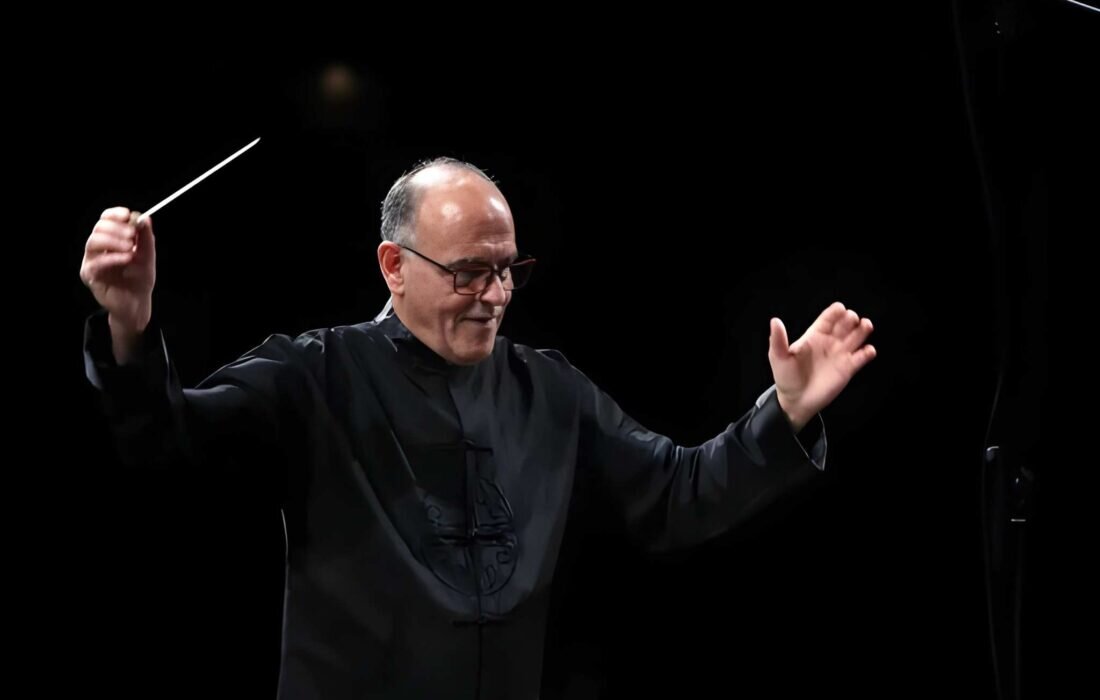
According to KhabarOnline, citing the Iranian Music Association, Nasir Heydarian is among the Iranian orchestra conductors who have linked their experience of working in Europe's professional music scene with the concerns of the Tehran Symphony Orchestra; a conductor in whose view leading an orchestra is not limited to controlling the beat and coordinating the musicians, but nurturing independent and capable musicians and providing the ground for the growth of a new generation of conductors is also part of his responsibility. After a short absence, Heydarian returned to Iran once again and last week took the Tehran Symphony Orchestra on stage with a repertoire of classical works.
We spoke with him about his professional path and his view of conducting, the Tehran Symphony Orchestra's programs, the difficulties of musicians' work in Iran, the experience of performing with the orchestra at Azadi Square in wartime conditions, and the necessity of preserving and performing works by Iranian composers:
First, will you tell us about the upcoming performance on October 20 (28 Mehr)? Which pieces have you chosen for this concert and what was the reason for this choice?
The pieces chosen for this concert were from the works of classical composers. This is my second concert after returning to Iran. The previous concert was devoted to Mozart, and this time works by Schubert and several other composers had been selected.
One of the pieces is Schubert's 'Italian-style' overture. In that period, at around 17 or 18 years of age, Schubert had written overtures in various styles, including Italian and Russian. One of these overtures had been chosen for performance. The next piece was a rondo for cello and orchestra, performed by Mr. Esmaeili-Solh. This piece was technically very difficult for the cellist.
After that, a work by Khachaturian was performed in which Armenian folk themes had been used. Also, the first and fourth movements were very challenging for the musicians, especially for the string players, from violin and cello to double bass.
The council usually, when choosing a program for the orchestra, pays attention to having works by composers of the classical period, such as Haydn, Mozart and the early composers of this period, in the program; works that have not yet fully entered the romantic space.
The important point is that these pieces are technically very useful for the musicians. The composers wrote these works in such a way that musicians can use them to practice and strengthen their technique. Many of the etudes available to string players today were written later; in the time of these composers, such etudes were not available in today's form. Therefore, by practicing these very pieces, musicians strengthened their technical skills; for this reason, choosing these works pursues two goals: on the one hand, the pieces are technically useful for the musicians, and on the other hand, they are beautiful works that can also be attractive to audiences.
After about five months away, have you returned to the orchestra with a fresh approach, or is the previous course to continue?
If you recall, over the past year works by Iranian composers were used in almost all the concerts so that Iranian music and composers could also be introduced; in some programs, the entire concert was devoted to a single Iranian work.
For example, the piece 'Falak-ol-Aflak' by Maestro Kambiz Roshanravan had a performance of about 80 minutes. Also, Mr. Tafazzoli's symphony was performed, which was about 80 minutes and took up the whole program. In other concerts too there has always been at least one work by Iranian composers; this time it was decided to change the repertoire somewhat and choose pieces that could attract more audiences to the symphony orchestra. Fortunately, the managers of the Roudaki Foundation also agreed to perform these works.
In the previous concert, tickets for both nights sold out within 24 hours. This time too the tickets were sold in the same period. The aim is for audiences to return to the symphony orchestra's concerts; for this reason, an effort is made to choose works that are attractive and that the listener can remember and even hum.
Another important matter is choosing young conductors so that the next generation of symphony orchestra conducting in Iran can take shape. I am about 70 years old and many of my colleagues are also of advanced age. Therefore, the ground must be provided for young conductors to take on the responsibility of the orchestra.
What challenges did the musicians face in this period's rehearsals? Were there particular problems in terms of playing?
When we work in Iran, we must take various conditions into account. Despite all the problems, an effort is made to hold good concerts alongside one another. I do not intend to exaggerate, but the musicians have always tried, as much as possible, to present their best performance to the audience. They practice and, despite the existing problems, try to maintain the quality of the work.
In your opinion, what duties does the conductor of a large orchestra like a symphony orchestra have? How can they display the artistic capacities of the orchestra?
If I speak of my own wish, I would like a day to come when each and every musician can themselves take on the responsibility of performing the music.
In rehearsals, the symphony orchestra's musicians have noticed that I sometimes step aside and force them to listen to one another. I do not want them to be dependent. It is sometimes imagined that the orchestra conductor enters the stage like a magician and a miracle happens with the movement of his hand; but that is not the reality. The conductor is the orchestra's colleague. I always draw this view from educational and philosophical ideas, including views related to Freud and the concept of education and upbringing. A good teacher, a good master and a good conductor must be able to raise their orchestra to be independent, not keep the musicians like children who are always in need of others.
The musicians are always told: you must score the goal yourselves; not everything should depend on the conductor. We must move away from the notion that the conductor absolutely must come for the orchestra to become better. Musicians must progress every day, whether they have a good conductor or not, so they can cooperate with the conductor and present a good concert. I disagree with the view that the orchestra conductor must absolutely be present to force the musicians to play well. The musician must understand this himself, love his instrument, be interested in his work, and also have personal practice at home. In that case, he can, alongside the conductor, present a good performance.
To raise the orchestra's standards, how much do we need the presence of guest conductors? Can a permanent and flexible conductor raise the orchestra's level?
A permanent conductor is important for the orchestra, because the orchestra needs a sound system and a distinct identity in its sound. The permanent conductor must be able to create such a sound in the orchestra; just like a piano, which must have a suitable sound.
But alongside the permanent conductor, the presence of guest conductors is also necessary. Guest conductors come with new ideas and may show the musicians points they had not previously noticed. They can introduce new sounds and methods to the orchestra.
This experience helps the orchestra become better and benefit from different ideas. Therefore, the symphony orchestra both needs a permanent conductor and must regularly use guest conductors so the musicians can benefit from their experience and fresh outlook.
One of the important topics in holding a concert is attracting audiences. When choosing this period's repertoire, did you also think about the appeal of the pieces for audiences?
Yes, this time pieces were chosen that could attract more audiences to the symphony orchestra. Of course, in this regard one must be very careful and take into account the realities related to classical music.
Austria is one of the important centers of classical music in the world, but there too there are problems in attracting audiences to classical music. It is sometimes imagined that because conditions abroad are different, all people like classical music; whereas that is not the case.
I always compare classical music with philosophy. For example, not everyone reads the books of Kant or Nietzsche, but more people read novels. Pop music is also more understandable and accessible for many people; they can easily listen to it and enjoy it.
In fact, classical music cannot be imposed on everyone, saying everyone must listen to it. Sometimes in Iran there is this wrong impression that everyone must listen to classical music, while just as not everyone turns to philosophy, not everyone necessarily becomes interested in classical music either. Of course, this does not mean no effort should be made to attract audiences. In Europe and Austria too, over many years, efforts have been made to create such an interest. I have seen examples of people with ordinary jobs, including university guards, going to classical music concerts and enjoying listening to them. Reaching such a state takes time, and one cannot expect everything to happen overnight.
Of course, there are also serious enthusiasts of classical music who save up to buy tickets and even cut their other expenses so they can go to a concert. This matter depends more than anything on the individual's interest and connection with this music. Fortunately, the symphony orchestra's concerts are met with a welcome, but efforts must be made for more audiences to become interested in this music.
The Tehran Symphony Orchestra, in the new management period, has had an organized and codified program. Will this planning continue for the second half of the year as well?
From the very first days, in the council, the programs were specified until the end of Esfand (March), and audiences can know which works will be performed in the coming months so they can plan to hear them. For example, someone who wants to come to a concert in Bahman (February) can know in advance which work will be performed. Of course, changes sometimes occur. Therefore, alongside long-term planning, there must also be the possibility of adapting to unforeseen conditions.
You were present in Iran's wartime conditions, and the symphony orchestra held a different performance at Azadi Square. For you, who had come to Iran from abroad, what feeling was it to be in those conditions and perform music? Was there fear?
Fear always exists in a corner of the human mind. One thinks that something might happen; these worries exist, but at the same time, life and work must go on. The orchestra's performance at Azadi Square was a very important experience. I hope such events are repeated more; because I believe these kinds of performances can attract more audiences.
The interesting point was that in that program, apart from two pieces with the theme of homeland and Iran, the other works were chosen from classical composers. Nevertheless, people welcomed and listened to the music; one of the pieces was very calm and had many piano sections. I asked those present not to talk so we could perform that part in silence. The people sat quietly and listened to the music, and in my opinion it was a very good experience.
I always think that as much as we can, we must bring joy and vitality back to society. One of the reasons I am present in Iran in these conditions is this very thing. I would like the orchestra's musicians, in these hard conditions, when they come for rehearsal, to be for a few hours in a space where they can perform good music and find a better spirit. On the other hand, I am happy when I see the musicians leave the hall after rehearsal in a better mood. During this time they distance themselves from everyday problems. The same applies to audiences: whoever comes to a concert that day should be able to listen to attractive music for at least an hour, forget their problems, enjoy an hour of music, and leave the hall in a better state.
Source: KhabarOnline