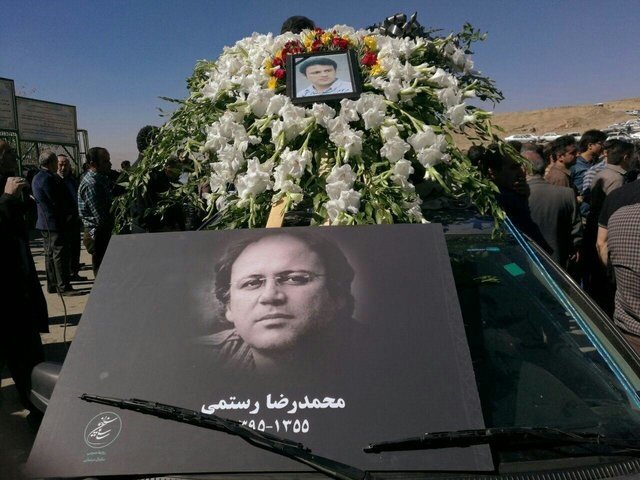
According to KhabarOnline News Agency, in the calendar of every living being's existence there are days that are never forgotten; October 20, 2016 is one of those days that will not be consigned to oblivion in the KhabarOnline newsroom, even if a decade has passed since then and, following inevitable generational change, young journalists now come and go in the newsroom whose knowledge of "Mohammadreza Rostami" is not the product of direct dealings with him but of things read and heard. The late journalist Mohammadreza Rostami, born on October 31, 1956 in Asadabad, Hamadan, began his work in the press in the 1990s and, after joining the editorial staff of the newspaper "Jam-e Jam" in 2000, wrote for more than 15 years until 2016 in various cultural and artistic fields, including theatre, music, cinema, cultural heritage, literature and more. He, who closed his eyes to the world on October 20, 2016 at Tehran's Shohadaye Tajrish Hospital after an unsuccessful surgery and due to a medical error, with his death grieved not only the KhabarOnline newsroom but also the media sphere in all three fields of literature, theatre and music, which laid to rest in the cold earth of the Imamzadeh Abdullah cemetery in the village of Shahrab (three kilometers east of Asadabad, Hamadan) one of its most well-read, most eloquent and most professional figures. On the tenth anniversary of Mohammadreza Rostami's passing, we take a look at some of his writings.

For that forty-year-old young man
On Ta'zieh
Ta'zieh, and in general the authentic arts, were among this journalist's concerns. He raised this subject in a report-interview with Hashem Fayyaz. The opening part of that report-interview is as follows: "The winter of 2002–03, the old Karaj road, a simple building and a korsi. For us sitting on this side, 'Tekyeh Dowlat' was only a name whose black-and-white image we had seen in Bahram Beyzaie's book 'Theatre in Iran'; but for Hashem Fayyaz, who sat across from us, the story had another shape. He was the last survivor of 'Tekyeh Dowlat' — a man who had learned ta'zieh-reciting from childhood in 'Tekyeh Dowlat' under the supervision of Mo'in al-Boka and with this art had amazed many, from Peter Brook, the world-renowned theatre director, to ordinary people who had witnessed his performances in various roles in corners of Iran. From that year until today nearly a decade has passed, and in this time much has happened, from the registration of ta'zieh as a world heritage by UNESCO to the death of Hashem Fayyaz, but his accounts of ta'zieh and ta'zieh-reciting are still alive and fresh."
Reza Rostami in "The unique features of a national art: Nasser Taghvai's account of ta'zieh and the documentary he made in Zavareh" wrote: "Prologue: If Khosrow Neshan had not been the head of Iran's Center for Dramatic Arts and had not invited Nasser Taghvai to make a documentary about ta'zieh, now a film like 'The Last Practice' would not have been made — a film that played a decisive role in the registration of ta'zieh as the spiritual heritage of the Iranians by UNESCO. Yet it found neither a path to the home-video network nor broadcast on the various IRIB channels. Taghvai had before this also turned to the rituals of different parts of Iran and in his youth made brilliant documentaries of these rituals. 'Arba'in' was one of these documentaries, in which the director of films such as 'Nakhoda Khorshid', 'Kaghaz-e Bikhat' and more turned to the Arba'in Day rituals in the city of Bushehr. His account of this national and ritual art of the Iranians, nine years after the making of the documentary 'The Last Practice', is worth reading..."
On Cinema
When Mohsen Amir-Yousefi's "Lovely Rubbish" and Rakhshan Bani-Etemad's "Tales" were not granted screening permits, Mohammadreza Rostami once again took up his pen. He wrote about Bani-Etemad's film:
"Rakhshan Bani-Etemad eludes definition — both herself and her cinema. This proposition may not seem logical, but it is true; the reason for this has less to do with the inefficiency of systems for classifying cultural products than with Rakhshan Bani-Etemad's journey beyond good and evil — a place where the human being stands with all his weaknesses and strengths and, in different situations, can display actions that lie at a far distance from the dichotomy of good and evil. Recall the brilliant sequence of the film 'Tales' (if you have had the chance to see it), where the man (Peyman Maadi) asks the woman (Baran Kosravi) to marry him and the woman says it is not possible, says that she has AIDS and thinks the man probably did not know when he made her such an offer; but the man, knowing this, has fallen in love with her and wants to live with her. This action is depicted in a simple situation (inside a van), a place enclosed between glass and iron. The mirror, with all the semantic burden it has found in our lyrical literature, is here too the messenger of gazes; the woman pauses, the man speaks, the man pauses, the woman speaks, and in this dialectic of word and gaze a world takes shape, full of hope — a world that leaves the dichotomy of good and bad, or good and evil, outside the van, so that the viewer who, in the temple of cinema, has reached imitation with an unreal world, praises the human being and love with his flesh, skin and blood. This situation is of course not unique to this film; traces of this view can be found abundantly in Bani-Etemad's cinematic world — a place where boundaries collapse into one another and the human being, with all his might, stands against determinism, against class, against being divided into good and bad, rebels, and shapes a world that cannot be interpreted with any label; this world refuses interpretation in order to take up a fresh dialogue with the audience that has encountered it — a dialogue from which various readings arise, and reading, as Paul Ricoeur says, is the opposite of interpretation, the opposite of chaining the work of art by imposing a meager reading..."
On Media
He always attached importance to the media and working in the media, and displayed part of this concern in a note titled McCarthyism in the Media Part of his writing is as follows:
"One day after Iranian filmmakers launched a campaign to support the nuclear negotiations and to tell the Western parties that 'any agreement with Iran is better than no agreement,' Seyyed Reza Mirkarimi, one of the 6 directors present in the campaign, uttered words that were worth pondering: 'Unfortunately, these days a business of forced confessions and inquisition of beliefs has been set up that is not worthy of our society.' Mirkarimi's remarks, although a reaction to the atmosphere created around the formation of such a campaign, hid within themselves a reality showing that the usual methods of informing in the field of culture and art have given way to methods that fundamentally have no affinity with the field of culture and art. In fact, the current that in the tenth government sought to securitize the field of culture and art, although it was defeated in the eleventh presidential election with Hassan Rouhani coming to power, its media base tried from the day after the election to use all available capacities to prevent the realization of the promises that Rouhani and his cultural team had pledged."
The ceremony of the tenth anniversary of the passing of Mohammadreza Rostami, writer and cultural journalist, will be held today, Sunday, October 25, at 5 p.m., in the meeting hall of KhabarOnline News Agency.
Source: KhabarOnline