Thought Desk: Compiled, corrected and edited by: Forouzan Asef Nakhaei: This article was published on October 21, 2026, on morningstaronline website in England. In the view of the Morning Star website, Europe's political elites, philosophically and operationally, evade accepting responsibility for their own neoliberal structural and economic crises by blaming external factors such as Russia and migrants for the recent unrest. They evade confronting the Europe-wide crisis of distrust in the system. From the standpoint of the psychology of projections, blaming the other provides a pretext for suppressing freedom of expression and justifying increased military budgets; while the real roots of the protests in France, Spain and Italy, and likewise the collapse of public services, the housing crisis and the diversion of resources toward rearmament in Britain, reveal the failure of the ruling economic model.
****
Blaming 'foreign instigators' for popular unrest is the oldest trick in history; and now EU regulatory bodies are investigating alleged pro-Kremlin 'influencers' who are supposedly stirring up unrest in France, Spain, Italy and elsewhere.
Another version of this narrative, which has rightly been accompanied by the condemnation of Donald Trump, the US president, by his French counterpart Emmanuel Macron, but is also promoted by Péter Magyar, the prime minister of Hungary, and Donald Tusk, the prime minister of Poland, is that migrants are to blame.
Both approaches evade confronting the Europe-wide crisis of distrust in the system. Both approaches encourage repression, whether repression of freedom of expression online or repression of entire minorities and communities. And both approaches are relevant to us in Britain as well.
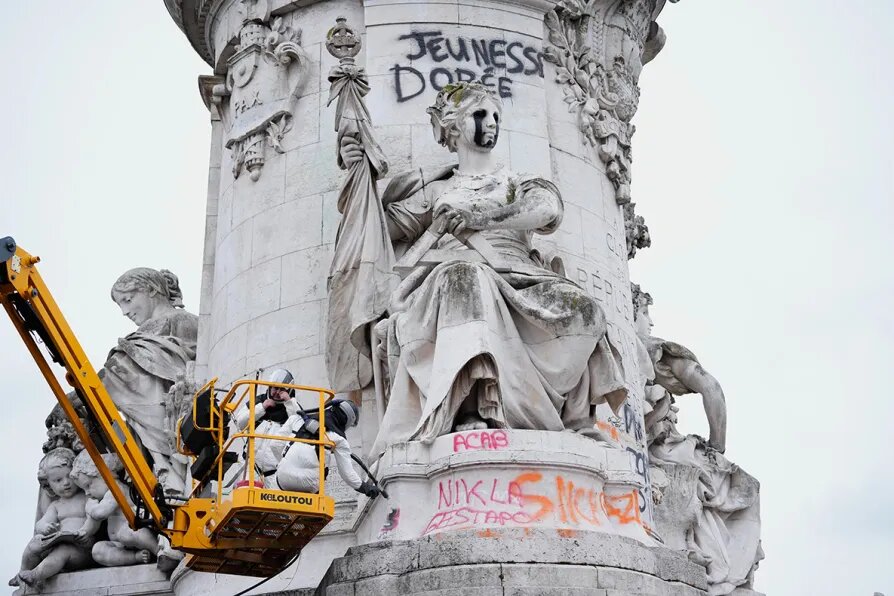
The issues raised on the European continent are our issues too. The direct cause of the protests in France was the schools' budget shortfall: dilapidated buildings and staff shortages, together with discontent related to workload pressure and the large volume of duties.
Here in Britain, too, we have faced scandals over crumbling school buildings and backlogs of repairs and renovations due to the Conservatives' cancellation of the 'Building Schools for the Future' programme. We face a teacher recruitment and retention crisis that will be made worse by unfunded pay increases. We have a hated inspection system that has been linked to suicides, and a test-driven, factory model of education that puts irresponsible pressure on children even in primary school.
In Spain, it was housing that lit the powder keg. Tenants' inadequate rights, alongside skyrocketing housing costs, have inflamed public anger.
In Britain, millions of people are trapped in the unfair private rental sector, including many who are on the threshold of retirement and have no guarantee that after their earning years end, they will have somewhere to live within their means. Housing costs in big cities, with London in extreme lead, have grown far beyond incomes, so that even above-average wages are often not enough to cover them. This system is exactly as unsustainable as Spain's.
Protesters in Italy have also objected to the huge diversion of resources toward rearmament; part of the same drift toward war that in Germany has also sparked a widespread student movement against conscription. Yet again in Britain, our government, while promising staggering increases in military budgets, pleads poverty on public-sector pay, the green transition and investment in infrastructure.
Europe's decaying political elites cannot accept that something fundamental must change. The roots of public anger, whether from collapsing public services or the cost of living, lie deep in the (neoliberal) economic model to which they are committed, a model that EU treaties have entrenched with the force of a constitution.
Blaming Russia serves several purposes: it shifts responsibility onto someone else; it provides a pretext for more state repression and for restricting freedoms that might be used to hold power to account; and it exaggerates the Russian threat and justifies increased military spending, which itself expands and deepens the crisis.
We know from Andy Burnham's attempt to blame Russia over Brexit that the same temptation exists here too. One of the reasons baseless claims about Russian puppet-masters need firm rejection is that these claims are an escape hatch that politicians use to avoid dealing with real problems.
Social media are powerful tools, and those who own and control the biggest platforms consequently have political influence; but here, the 'elephant in the room' (the big, ignored problem) is surely the United States, Meta, X, Google, and their closeness to Donald Trump's far-right government.
And even so, they need a tinderbox to ignite. Europe's 'omnicrisis' will only be solved by a political and economic alternative: investment in the industries and jobs of the future, public ownership of strategic assets, and an end to the plundering of public property by parasitic profiteers.
Fortunately, our prime minister promised something of this kind when he announced the end of 40 years of neoliberalism. But the policies he has announced to date have been weak. The budget is an opportunity to show he stands by his word. If not, the main puzzle will not be why the French are on the streets, but why we are not on the streets.
Source: KhabarOnline