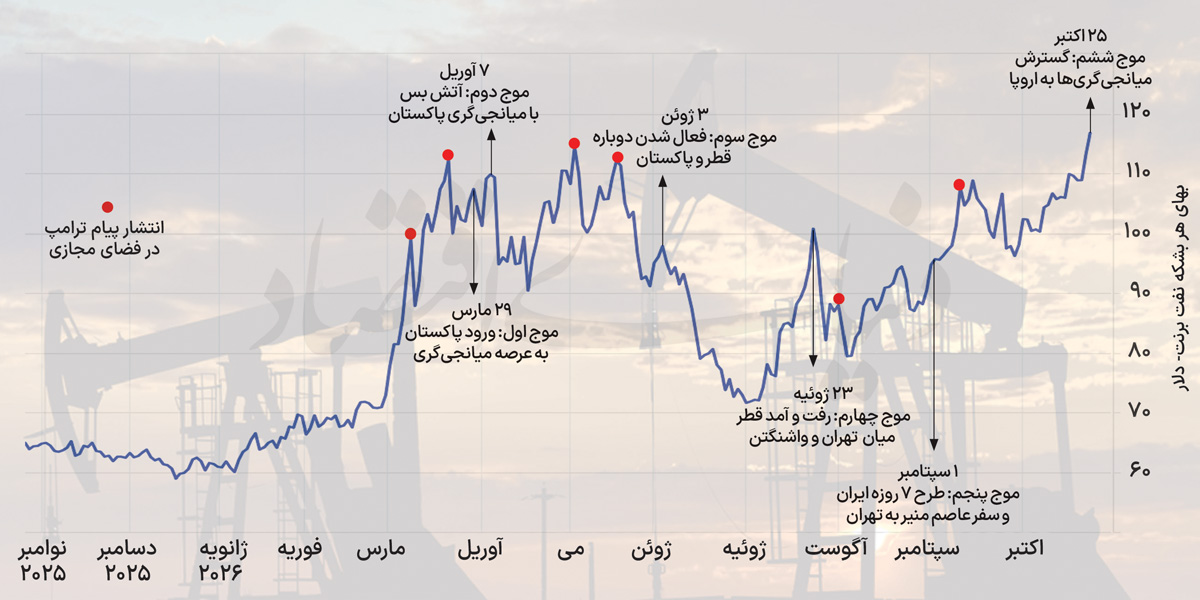
Today is October 25, 2026, and 239 days have passed since the US and Israeli attack on Iran (February 28, 2026) and the beginning of the 40-day war, and 201 days have also passed since the ceasefire (April 7, 2026); a ceasefire that was violated on July 8, 2026, and the US imposed another military conflict on Iran that lasted 17 continuous days and afterwards continued sporadically. Yesterday, Al Arabiya claimed that Iran had, through Pakistan, presented a proposal to the US that included reopening the Strait of Hormuz in exchange for lifting the US blockade, but Tasnim announced that this news is a lie.
Read the developments related to the war, ceasefire, and negotiation in the past day from the link below:
The news related to the war, ceasefire, and negotiation on the current day, October 25, 2026, is as follows:
Erem News wrote: European diplomatic sources revealed that Germany, France, and Britain have prepared a comprehensive initiative to present to Iran and the United States, which is implemented in two stages. This plan begins with an agreed settlement of the Strait of Hormuz issue and the lifting of the blockade, and then reaches the stage of negotiations on a comprehensive nuclear agreement and the settlement of the issues related to sanctions and blocked assets. The basis and reference of these negotiations will be the mechanisms and principles of the 2015 nuclear agreement.
According to Entekhab, the article continues: European diplomatic sources explained in conversation with “Erem News” that Paris, Berlin, and London are preparing this initiative so that in the first stage, they take on the role of guarantor. This stage focuses on achieving an agreement for reopening the Strait of Hormuz and lifting part of Iran's blockade.
The goal of this action is to pass through the state of mutual distrust and examine the possibility of achieving “mutual concessions” in the form of a temporary and transitional deal.
After the completion of this agreement, the initiative enters the second stage; a stage that includes negotiations on reducing the level of uranium enrichment based on a specific timetable and applying international oversight on Iran's nuclear facilities. The facilities that must be placed under oversight will be determined by the International Atomic Energy Agency.
Mutual concessions in the second stage
Based on the initial framework of this initiative, in return for Iran's actions, part of the sanctions will be lifted and the blockade will also be completely removed. These actions will take place in the form of a mechanism that is developed based on the 2015 nuclear agreement; the agreement from which Donald Trump, the President of the United States, withdrew during his first term of presidency.
These developments are taking place while Johann Wadephul, the Foreign Minister of Germany, has recently announced that Germany, France, and Britain are ready to negotiate with Iran to prevent this country from achieving nuclear weapons; and that in conditions where the signs of the escalation of tension between Tehran and Washington in the coming days are on the increase.
A French diplomatic source said the European troika, in the framework of the effort to revive its role in the negotiations, is seeking to find realistic solutions for the unresolved issues that have caused economic and military tensions at the international level.
According to this source, Europe is a main partner in resolving the crisis of the nuclear file and intends to present a plan that includes applying limitations on uranium enrichment and creating verification mechanisms at Iran's nuclear facilities; in return, the sanctions be reduced and the issue of Iran's blocked assets also be settled.
This French diplomat continued to “Erem News”: Paris, Berlin, and London believe that the inability to achieve a solution for the current tensions from last February until now is due to the multiplicity of issues and differences between Washington and Tehran.
According to him, this situation requires that the issues of the Strait of Hormuz and the blockade be taken out of the circle of conflict and that the two sides, as soon as possible, enter an agreement mechanism on the main issue, namely the nuclear file; a mechanism that provides a dynamic process for addressing all the existing differences in the negotiations.
On the other hand, a former adviser to the Foreign Relations Committee of the German Parliament explained that Trump will not accept any European initiative to intervene in the process of achieving an agreement with Tehran; because such an action means that he, by accepting Europe's role, practically confesses that he made a mistake in exiting the nuclear agreement in 2018, went to excess in this path, and was incapable of managing Iran's file. Also, this perception is strengthened that Benjamin Netanyahu, the Prime Minister of Israel, pushed him into a path that has harmed the interests of the United States.
This former advisory source in the German Parliament told “Erem News” that Trump does not want a powerful mediation by the European side; because he considers such mediation a sign of the weakness of his own foreign policy; a weakness that can also affect the Ukraine war file and cause the linkage of the two files of Iran and Ukraine; a subject that may harm his understandings with Vladimir Putin, the President of Russia.
The 2015 nuclear agreement, which was known by the title “Joint Comprehensive Plan of Action,” included limiting the level of uranium enrichment to a maximum of 3.67 percent for 15 years and reducing the number of Natanz centrifuges to about five thousand first-generation machines for 10 years.
In return, after the implementation of the related commitments, a set of nuclear sanctions against Iran would be lifted or suspended so that the possibility of carrying out part of the international commercial, financial, and oil exchanges would be provided for Tehran.
Mohammad Abol Enein, a researcher of strategic issues, believes that if this European initiative is implemented, the extent of its success can be evaluated with regard to the nature of the diplomatic relations of the three European countries with Washington and Tehran and also their ability to influence America's decision; especially in conditions where Washington has spoken of the possibility of moving toward the escalation of tensions, whether before the congressional midterm elections or after them.
Abol Enein told “Erem News”: If Europe's effort remains limited to the level of traditional diplomacy, the crisis will remain in its current state. But if this effort turns into the formation of a coalition that has the readiness to play a real role in the negotiations, it can have a positive effect on the course of developments and be a step forward to stop the escalation of tensions.
He added that if such an action is taken, Europe, on the one hand, will strive to provide the possibility of negotiation with Iran about preventing this country from achieving nuclear weapons, ensuring the security of shipping routes, and preventing the escalation of tension, and on the other hand, does not want the tools of escalating tension to remain solely in the possession of the United States; and that in conditions where other countries, including European countries, are also harmed by the negative consequences of this confrontation, the most important of which is the increase in the price of energy.
This researcher also pointed out that if the Europeans, upon entering this path, succeed in creating practical and real mechanisms, they may to some extent prevent the escalation of tensions whose possibility of occurrence exists at any moment. Among the signs of this escalation of tension, one can point to the trip of Pete Hegseth, the US Secretary of War, to Israel and the increase in the gathering and deployment of military forces in the regions around Iran.
Abol Enein said in the end that turning Europe's diplomatic efforts into practical initiatives can create an obstacle against the escalation of tensions; but the realization of this goal depends on the extent of Washington's and Tehran's accompaniment with these efforts and the extent of the two sides' desire to accept diplomatic proposals that can prevent the restart of confrontation and settle the contentious differences through negotiation.
Fars wrote: Pakistan reopened the Gabd–Rimdan border crossing with Iran after a one-week halt.
Based on the information received, Pakistan reopened the Gabd–Rimdan border crossing in the Gwadar region, and the passage of trucks carrying liquid gas and essential goods was resumed.
This is while in the less than one week that has passed since Islamabad closed this crossing for security reasons and to confront smuggling, the price of gas in Pakistan broke a record.
Pakistan imports about seven thousand tons of liquid gas daily from Iran, more than four thousand tons of which pass through the Gabd–Rimdan crossing; according to Reuters, with the non-export of energy from Iran to Pakistan, this country will suffer a fuel crisis.
The Times of Israel wrote: Polls published by Israeli television networks show that the “Yashar” party led by Gadi Eisenkot is at the top, and after it is the Likud party led by Netanyahu. The Reservists' party led by Yoaz Hendel succeeded in passing the electoral threshold in one of the three polls, but Ofer Winter's party was prevented from entering the Knesset.
According to Entekhab, the article continues: The final polls that were published on Friday, before Israel's nationwide elections next week, indicate the continuation of the political deadlock. Based on these polls, neither the current ruling coalition nor the so-called “change” camp will be able to form a government after the elections. It is also predicted that a large number of small parties will not be able to pass the electoral threshold.
The publication of polls is prohibited from Saturday, and this prohibition will continue until the time of the publication of the exit polls at the moment of the closing of the polling stations at 10 p.m. on Tuesday.
Channel 13 poll: The change camp 54 seats and Netanyahu's coalition 50 seats
The Channel 13 poll predicted that the parties opposed to Benjamin Netanyahu, the Prime Minister of Israel, would obtain a total of 54 seats, and the parties loyal to the Prime Minister would also gain 50 seats. Both camps will fall short of achieving 61 seats, namely the minimum seats necessary to gain a majority in the Knesset.
Based on this poll, the mostly Arab parties will also obtain 16 seats.
After these parties is the joint list of the mostly Arab parties with 9 seats.
* The Religious Zionism Party: 6 seats
The Ra'am Party: 5 seats
Mansour Abbas, the leader of the Ra'am party, has said that he has the readiness to join the coalition of the change camp; however, several parties that are members of this camp have announced their opposition to this party's presence in the government.
The Channel 12 poll also showed that the parties of Ofer Winter, Yoaz Hendel, and Moti Leitner will not succeed in passing the electoral threshold and entering the Knesset.
Finally, the poll of the public Kan network also showed a similar result; with the difference that based on this poll, the Reservists' party led by Yoaz Hendel will succeed in entering the Knesset by gaining 4 seats.
Hendel has so far not publicly announced which of the two political camps he will support.
Therefore, the Kan poll predicted for the change camp only 52 seats, for the current ruling coalition 50 seats, for the Arab parties 14 seats, and for the Reservists' party 4 seats.
This poll, like the other two polls, showed that the parties of Ofer Winter and Moti Leitner will not pass the electoral threshold. Both parties have announced that they will remain in the elections until the end of the competition and have rejected the pressures of Netanyahu and his allies to withdraw.
The Channel 13 poll was conducted by Shmuel Rosner and Noah Slapacoff of the “Madad” polling institute. This poll included 1,875 respondents, and its margin of error has been announced as 2.3 percent.
The Channel 12 poll was conducted by Mano Geva of the “Midgam” institute with the participation of 1,018 people, and its margin of error was 4.4 percent.
The Kan network poll was also conducted by Dodo Hasid of the “Kantar” institute. In this poll, 1,106 people participated, and its margin of error was 3 percent.
These polls were published one day after the “Times of Israel” website, the sister media of The Times of Israel, published its last poll before the elections. Based on that poll, each of the two main camps led by Jewish parties obtains 51 seats, the parties led by Arabs obtain a total of 14 seats, and the Reservists' party obtains 4 seats.
Given that all the polls indicate a political deadlock after Tuesday's voting, the only way for one of the two main camps to reach a majority will be to retreat from the election promises of not cooperating with some other parties.
If neither of the two camps can create a coalition to form a government, repeat elections will be held; elections that are scheduled to be held in early 2027. In this interval, Benjamin Netanyahu will remain in power as the prime minister of the interim government.