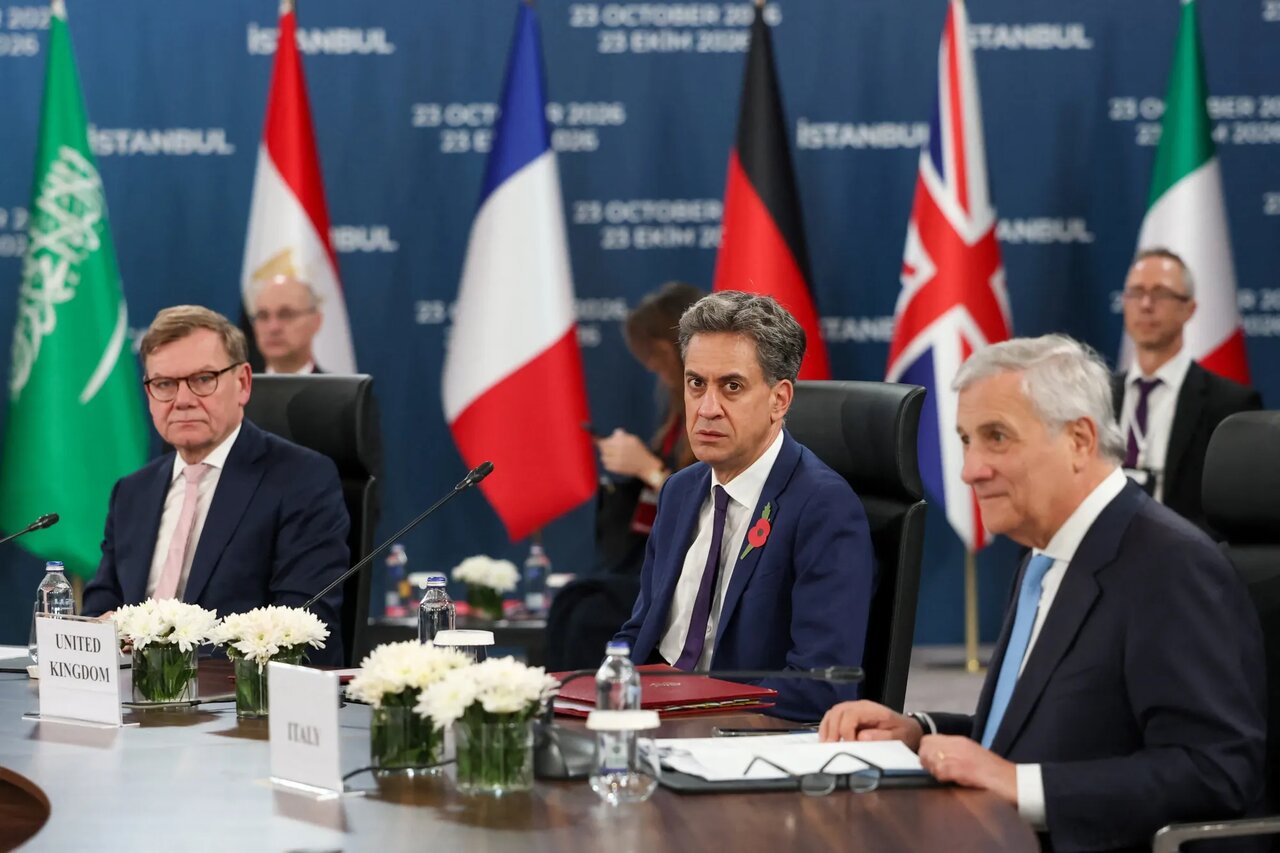
According to KhabarOnline, the Erem News news-analytical website, in an exclusive report by Mohammad Hamed, wrote that European diplomatic sources have revealed the preparation of a two-stage initiative by Germany, France and Britain to be presented simultaneously to Iran and the United States.
This initiative is founded on the principle that the Strait of Hormuz dispute and the trade blockade must be resolved as a first step, so that the ground is prepared for agreement on the nuclear file and the lifting of sanctions.
Informed European sources stated that Paris, Berlin and London will assume the role of guarantor in the first stage; a stage that includes agreement on guaranteeing safe navigation in the Strait of Hormuz in exchange for a partial lifting of the economic blockade against Iran, so that the wall of distrust is broken and the parties enter a trade-off of concessions.
After this step is consolidated, the plan will enter its second stage, where negotiations are devoted directly to reducing the level of uranium enrichment according to a specific timetable and the return of International Atomic Energy Agency inspections.
In return for implementing these technical commitments, part of the sanctions will be lifted, the economic blockade will be completely stopped, and a mechanism will be devised for releasing Iran's blocked assets based on the framework of the 2015 nuclear agreement (the JCPOA).
Intensive Diplomatic Consultations Ahead of the Crisis Exploding
A French diplomat told the outlet that the official announcement of this package is contingent on the outcome of confidential contacts with Tehran and Washington and on obtaining initial agreement on its broad lines.
These moves intensified after Johann Wadephul, Germany's foreign minister, officially stressed the troika's readiness for intensive negotiation with Iran to prevent it from acquiring a nuclear weapon, amid signs that direct confrontation could strengthen in the coming days.
The French source noted that the troika seeks to revive its pivotal role in the nuclear file, since the recent months-long crisis stems from the excessive entanglement of the files, and as long as field issues such as the Strait of Hormuz and the economic blockade are not resolved, entering technical nuclear negotiations will be impossible.
White House Obstacles; Why Won't Trump Accompany the Europeans' Mediation?
Despite the bustle of European capitals, observers view Washington's position with pessimism.
A former adviser to the German parliament's Foreign Relations Committee stressed in this regard that Donald Trump, the US president, will reject any European plan for a settlement, because accepting it would mean admitting the failure of the strategy of withdrawing from the JCPOA in 2018, the futility of the directions of Benjamin Netanyahu, Israel's prime minister, to Washington's interests, and the inability to curb Iran's regional power.
This expert added that Trump regards strong European mediation as a sign of weakness in his foreign policy, and worries that tying the Iran file to developments in the Ukraine war would overshadow his possible agreements with Vladimir Putin, the president of Russia.
Technical Dimensions of the Initial Agreement and Assessing the Costs of War for Europe
Under the terms of the 2015 agreement, the uranium enrichment cap had been set at 3.67 percent, and about 5,000 first-generation centrifuges remained active at Natanz, in return for which Iran's financial, trade and oil-export arteries were opened.
Dr. Mohammad Aboul-Enein, a researcher in strategic affairs, believes that Europe's effort is an attempt to prevent Washington's monopoly over the tools of escalation, since in the event of a confrontation, the greatest economic damage, including staggering energy price increases, will be imposed on the European economy.
In his view, definite signs of the parties' determination for confrontation (such as the secret trip of Pete Hegseth, the US Secretary of Defense, to Israel and the increased military concentration of the US fleet near Iran's borders) show that traditional diplomacy is ineffective, and only if Europe can define real levers on the ground will it be able to stop the war machine ahead of the congressional elections.
42/42
Source: KhabarOnline