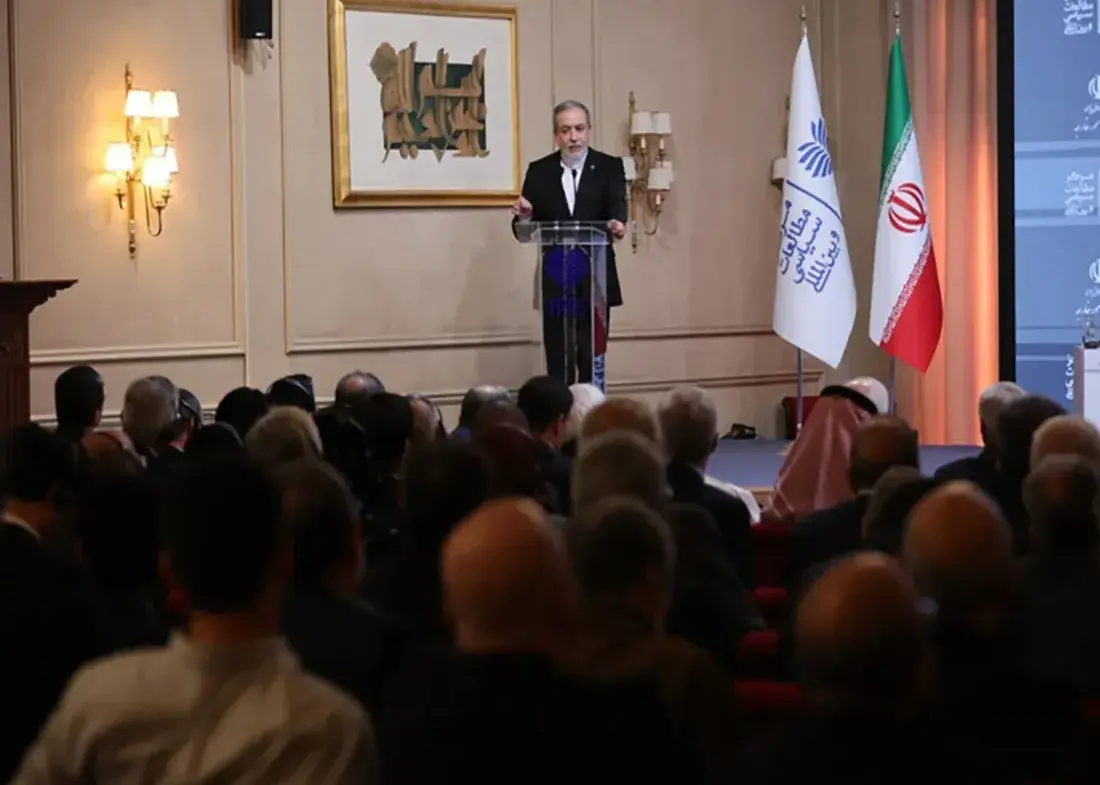
According to Varzesh3 and quoted from IRNA; Seyed Abbas Araghchi, the minister of foreign affairs, on Sunday, October 25 (3 Aban), at the opening ceremony of the "Center for Documents and Museum of Martyr Seyed Kamal Kharazi," while appreciating the organizers of today's meeting, said: today the documents center in the name of Martyr Kharazi will be opened, and the library too, after reconstruction, will resume its work completely. Just as we reconstructed the library, God willing, we will also reconstruct Iran in this same way, and we shall.
The text of the foreign minister's speech is as follows:
Martyr Kharazi had a firm belief in the ideals of the Revolution and the principles of Iran's foreign policy
In describing Martyr Seyed Kamal Kharazi, many words have been said in various ceremonies and occasions, and you too have heard these matters. Allow me to point here to one of his prominent features and then address another point that I intend to state.
In my opinion, the prominent feature of Martyr Kharazi was revolutionary rationality. We all knew him and knew to what extent he was a person of thinking, thought, consultation and dialogue. He really was a man of dialogue and a man of diplomacy. In our country, many people enjoy these features, but Martyr Kharazi was one of the prominent examples of a personality whom one can name a man of dialogue and diplomacy.
Alongside this feature, he also enjoyed a revolutionary spirit and believed from the bottom of his heart in the ideals of the Islamic Revolution and was adherent to them. I, during his ministry and also during the period in which I had the honor of cooperating with him in the Strategic Council of Foreign Relations, witnessed well this belief and adherence.
Martyr Kharazi had a firm belief in the ideals of the Islamic Revolution and the fundamental subjects of Iran's foreign policy, including the current of resistance and the issue of Palestine. These ideals were important for him from before the Revolution, and after the Revolution too, he not only remained adherent to them, but also defended them in practice. Revolutionary diplomat was befitting of Martyr Kharazi.
He remained loyal to his ideals, and for this reason, even after the end of his ministry period, he continued activity as an advisor to the Supreme Leader and undertook the presidency of the Strategic Council of Foreign Relations; a council that played the role of the advisory arm of the Leader of the Revolution.
Martyr Kharazi also played an important intellectual role in this period. The consultations that were prepared and presented in the Strategic Council of Foreign Relations for the Supreme Leader were the result of hours of discussion, consultation and dialogue in the council's meetings, and the results of these discussions were reflected in the form of expert consultations.
The security of the region must be provided endogenously and without foreign interference
"Neighbors are not rivals; they are the main partners of Iran for a peaceful future"
Martyr Seyed Kamal Kharazi became a member of the Expediency Council; a position that indicated his merit for participation in discerning the expediency of the country and the system of the Islamic Republic, and the Leader of the Revolution appointed him to this important position. The last time I had a meeting with him was at the conference of Iranian-Arab dialogues, which was held in May 2025 (Ordibehesht 1404) in Doha. This conference was held continuously between the Strategic Council of Foreign Relations of Iran and the Al Jazeera Studies Center in Qatar, and its fourth round too was held in Ordibehesht of last year, exactly one month before the aggression of the Zionist regime and America against Iran on June 13, 2025 (23 Khordad 1404).
In that conference, whose main subject was regional issues and the relations of Iran and the Arab countries, Martyr Kharazi raised points about the foreign policy and neighborhood policy of the Islamic Republic of Iran that I would like to review once again.
He had said: "The flourishing of a region, before everything, requires the collective commitment of the members of that region to peace and stability. The future of every region must be shaped by the hands of the countries of that same region and based on mutual respect, sovereign equality and a feeling of common responsibility; because collective security is not an imported matter, but must be created from within and without foreign interference.
The Islamic Republic of Iran supports the creation of comprehensive and sustainable platforms for dialogue among the countries of the region with the aim of developing peace, stability and flourishing. We emphasize active diplomacy and the peaceful settlement of disputes. From our point of view, neighbors are not rivals; rather, they are our main partners in achieving a peaceful future. Iran is ready for bilateral and multilateral dialogues so as to strengthen transparency and trust and reduce misunderstandings."
These were expressions that Martyr Kharazi stated about one and a half years ago at the conference of Iranian-Arab dialogues about our regional policies. Today, after the passage of this period and the occurrence of two great wars in the region and conflicts that still continue, I want to emphasize that our policy is still the same policy that he explained. Our policy has not changed, and we still believe the region must enjoy a peace and stability that is provided endogenously, by the hands of the countries of the region and without foreign interference.
After the recent wars, the region will not be like the past
The wars of the past one and a half years, especially the Ramadan War and the 40-day war, are considered a turning point in the history of the region. These wars disrupted the existing security structures and changed the conditions of the region. This is a reality that the world, the countries of the region and all of us must pay attention to; nothing else will be like the past.
These wars showed that the security structures of some countries of the region, which relied on foreign presence and interference, did not have the necessary efficiency. The American bases in the region did not bring peace and security for the countries that hosted them; rather, on the contrary, the existence of these bases itself became a factor for insecurity. These bases participated in the attack on the Islamic Republic of Iran and, in return, also received a reaction. Therefore, instead of creating security, they fueled the intensification of insecurity. Now this subject is seriously being discussed in the region.
Also, the role of the Zionist regime has become evident for everyone. From our point of view, this regime is the main factor of instability and warmongering in the region; a regime that has always prevented the establishment of security and stability and has been in pursuit of warmongering and weakening the countries of the region. These are lessons that have been taken from the past wars and have now driven the region toward revising its view and security approaches. We, in principle, welcome every action that leads to the creation of endogenous security in the region and the strengthening of the reliance of the countries of the region on their own capacities.
Iran's neighborhood policy is based on peaceful coexistence with neighbors
The end of the war must include all fronts
The countries that today are in pursuit of providing their security through cooperation and agreement with each other have, from our point of view, begun a correct move; although there are also questions, ambiguities and concerns that must be removed. Our region, in order to achieve peace and stability, must move toward a direction where the presence of foreign forces in it reaches zero. These forces have come to the region with the aim of providing their own interests and in principle for the protection of Israel and providing its security, and the continuation of their presence will have nothing but insecurity for the whole region in its wake.
The interesting point is that in practice too it was proven that these forces are neither able to protect Israel, nor can they protect their host countries, nor are they even able to provide their own security. The statistics that the Pentagon has presented are clear. According to him, almost all the bases of America in the region have been damaged and hundreds of buildings in these bases have been destroyed. Also, the Americans in this war have lost more than 80 aircraft and fighters, which, according to him, almost all of them were targeted on the ground and in the missile attacks of Iran.
Therefore, the same policy that Martyr Kharazi stated before the two past wars is still the principled policy of the Islamic Republic of Iran: the security of the region must be provided by the hands of the countries of the region themselves and without reliance on foreign forces and their presence. The Islamic Republic of Iran is ready for the realization of this goal and is ready for dialogue in this regard.
Our neighborhood policy is based on peaceful coexistence with neighbors. We have been, are and will be neighbors of each other; therefore, we must arrive at a common solution for providing our security and that of the region, in which all the countries of the region are present and no foreign force interferes in it.
Another important point is that, from our point of view, all the issues of the region are tied to each other. One cannot have war and conflict established in a corner of the region and in another corner expect peace and calm. For this reason, we, in all the negotiations that we have conducted with the American side, with the mediation of Pakistan, Qatar and other friends, have emphasized that the end of the war must include all fronts and the conflicts on all fronts come to an end; otherwise, we will not witness stability in the region.
The routes and the administration of the Strait of Hormuz will not be like the past
Two attacks on Iran have shown their result to the attackers
In the region, fundamental and strategic changes have taken place, and nothing else will be like before the 40-day war and the Ramadan War. Among these changes is the situation of the Strait of Hormuz. The Strait of Hormuz has been open for decades, and neither Iran nor Oman, as the two coastal countries of this strait, have created any obstacle for passage and movement; rather, on the contrary, they have established security and safety and have taken care of the environment. But the present war has changed everything. We must accept that new realities have become sovereign. The routes in the Strait of Hormuz will not be similar to the former routes, and the administration of the Strait of Hormuz too will not be like the past. There are cases about which we have negotiated, and these negotiations will still continue.
These days there is talk of the occurrence of another war, but I, from right now, am thinking of after the war. Whether war happens or not, our policies are in their place. If there is rationality, they will no longer try a military attack and aggression against the people of Iran. They have tried this work twice and have seen its result. If they want to try it one more time too, they themselves know that they will not obtain a result other than what they obtained in the past.
Therefore, allow us to think of after the war. We and the countries of the region must live in this region in peace alongside each other; without foreign interference. This is the only path of peace, security and stability in our region, and we are ready for cooperation with all the countries of the region, especially the countries of the Persian Gulf area.
Our policy has been this and still is this. Our connections with all the countries of the Persian Gulf region are established, and we strive to arrive at a common approach and a common understanding about the new security structure in the region. This is the only path of establishing peace and stability in our region.
Source: Varzesh3


No comments yet — be the first to share your view.