Kerman's Potters' Caravanserai Has Cracked; the Historic Building, a Gathering Place for Addicts
Kerman – Wall to wall with one of Kerman's malls, one of the most beautiful historic caravanserais is falling apart and has become a gathering place for addicts and a depot for scrap.
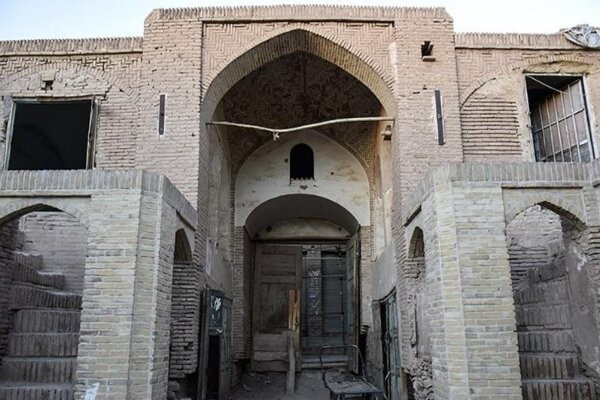

Kerman – Wall to wall with one of Kerman's malls, one of the most beautiful historic caravanserais is falling apart and has become a gathering place for addicts and a depot for scrap.
Mehr News Agency – Provinces Group: In the heart of Kerman's historic fabric, in Qaleh Bazaar, where the Qaleh Bazaar row splits the history of Kerman and reaches the Chaharsuq, there is a building that was once filled not with trash but with the pleasant smell of clay and the art of pottery.
This building, which in the not-so-distant past was a place for buying and selling and making pottery vessels, is now, however, a picture of neglect of a national heritage in the shadow of new constructions with unfamiliar architecture.
This Qajar building, which was registered in the National Heritage List on May 15, 2001 under number 3862, is today not a place of trade in pots and vessels but a refuge for addicts, a warehouse of trash and construction rubble, and a gathering place for thugs and ruffians.
Wall to wall with the Potters' Caravanserai, one of Kerman's big malls has been built, and thousands of Kermanis visit it every day, but the ancient Potters' Caravanserai has no visitors other than addicts, and the longing for the restoration and reconstruction of this beautiful building has remained in the hearts of the people of Kerman.
Meanwhile, this historic building, which is undoubtedly one of Kerman's most beautiful ancient two-story buildings and is made up of hundreds of beautiful columns and valuable cells, has seen one of the wealthy complexes in its precinct carry out construction.
Alongside the question of how Kerman's Cultural Heritage granted the permit for this construction, the officials of this commercial center should be expected to at least take a step toward restoring the Potters' Caravanserai, and for the tourism capacity of this building to be used to develop the province's tourism.
The Paradox of Neglect of Historic Buildings and Modernity
What turns this situation into a bitter paradox is the adjacency of this dilapidated building to one of Kerman's largest modern commercial and recreational complexes; a complex that, with its blinking lighting and shiny showcases, displays another face of the city.
The distance between the two is not a few meters but a few decades: on the one hand, a structure that was supposed to be linked with tourism and the urban economy, and on the other hand, a building that in the silence of the night has become a place of injecting and using narcotics.
In each of the cells of this caravanserai, which are nearly 50 cells, a huge volume of drug-use equipment has been discovered, and some cells are filled with syringes.
The governor of Kerman, from whom, as someone expected to take steps regarding tourism and the revival of the city's historic fabric, it is expected that by visiting this historic caravanserai after years of silence by Kerman officials, he will provide the ground for the revival of this unique building.
The story, however, goes beyond abandonment. The huge constructions in this building's precinct have dealt the final blow.
The root of part of this deadlock must be sought in the ownership structure.
The Potters' Caravanserai is privately owned, and this very fact has made any unilateral action by the Cultural Heritage face complexity.
Kerman Province Cultural Heritage managers have repeatedly announced that they have warned the owner to act to settle and restore the building, but the high cost of restoration and the lack of cooperation have driven these warnings into a deadlock.
In the meantime, what is sacrificed is not just a historic building, but the historical identity of the citizens in whose name this national work is registered.
But another question that arises is the role of supervisory bodies in settling such buildings.
The Potters' Caravanserai has today become a symbol of a structural problem in Kerman's cultural heritage management: how can one, on the one hand, speak of the world registration of the bazaar and the development of tourism, and on the other hand, leave one of the components of this very historic bazaar to its own devices to be buried under heaps of trash and indifference?
The answer to this question will determine the fate not only of this caravanserai, but of the credibility of Kerman Province's entire approach to its cultural heritage, and as long as this question remains unanswered, the Potters' Caravanserai, with its cracked walls and cells under destruction, presents a picture of the wrong approach.

Officials Should Come to the Aid of the Potters' Caravanserai
Omid Ebrahimi is among the cultural heritage activists in the city of Kerman who criticize the unfamiliar constructions on the margins of the bazaar and Kerman's historic buildings.
He said: The Potters' Caravanserai is one of the nationally registered buildings of Kerman's bazaar, which has a unique architecture and has suffered serious damage as a result of the interventions carried out.
He emphasized the need to restore the Potters' Bazaar and added: Some of the columns of this caravanserai have been destroyed or have broken, and action must be taken to protect and maintain this building.
Ebrahimi continued: In historic cities, such places become centers for attracting tourists, and the current situation of this caravanserai is deplorable.

Kerman's Valuable Historic Buildings Should Be Settled
Sajjad Poursani, another researcher and cultural heritage activist of Kerman, in an interview with a Mehr reporter, referring to the existence of various caravanserais that are privately owned and whose doors are closed or are being destroyed, said: Kerman Province officials and supervisory bodies must devise a solution to remove the restoration deadlock of these buildings.
He added: The private ownership of these places has caused these unique buildings, which are sometimes unmatched in the country, to be exposed to destruction and consigned to oblivion.
He stated: Kerman Province officials must carry out practical and urgent work to restore and maintain Kerman's historic buildings and not allow the historic assets of the city of Kerman to be destroyed so easily.

Kerman's Governor Should Become the Savior of Kerman's Bazaar
Haj Agha Reza, 78, an old bazaari of the Qaleh Mahmoud row, also spoke with a Mehr reporter in this regard.
He, who has spent more than six decades of his life in this very bazaar, with a cane in hand and a gaze scanning the cracked walls of the caravanserai, said: When I was a child, this place was full of the sound of the sewing machines of quilt-makers. Potters brought their pots from Sirjan and Bardsir and sold them in these very cells; now look, the cells are filled with trash and some of them have remained under rubble. This building was built with the money and art of the people of this very city and is nationally registered.
He continued: I ask the governor of Kerman to come in person and see up close that this building is our city's identity card, and if it is lost, nothing else will take its place.
He said: We ask him to order that a solution be devised as soon as possible to save this caravanserai.
Hajieh Khanom Zahra, 72, who lives in the Qaleh neighborhood, also asks Kerman officials, especially the governor of Kerman, to come to the aid of Kerman's bazaar, especially the Qaleh Bazaar row.
She, who has lived for years in the alleys of the Qaleh neighborhood and whose memories are tied to coming and going to the bazaar and this caravanserai, said: In my youth, my mother would send me to this very caravanserai to buy pots and pottery vessels; in those days this place smelled of clay and color and pattern, but now when I pass by here, my heart sinks, and instead of tourists coming to see the art of our ancestors, it has become a place of addicts and trash.
She, emphasizing that citizens have repeatedly asked officials to address the situation of this building but have gotten no result, added: I ask the governor of Kerman to enter this issue. We know that he has extensive experience in the field of Yazd's historic fabric, and organizing Kerman's bazaar is also doable.
These two Kermani citizens, while appreciating the media's attention to this issue, emphasized that saving the Potters' Caravanserai is not just a restoration action, but a step toward preserving Kerman's historical and cultural identity, and they expect the governor of Kerman, by seriously entering this case, to provide the ground for reviving this valuable heritage.
Source: Mehr News Agency
Comments (0)
Related stories

Tokyo Film Festival kicks off on a rainy red carpet
UNESCO Evaluator Arrives in Masuleh

No comments yet — be the first to share your view.