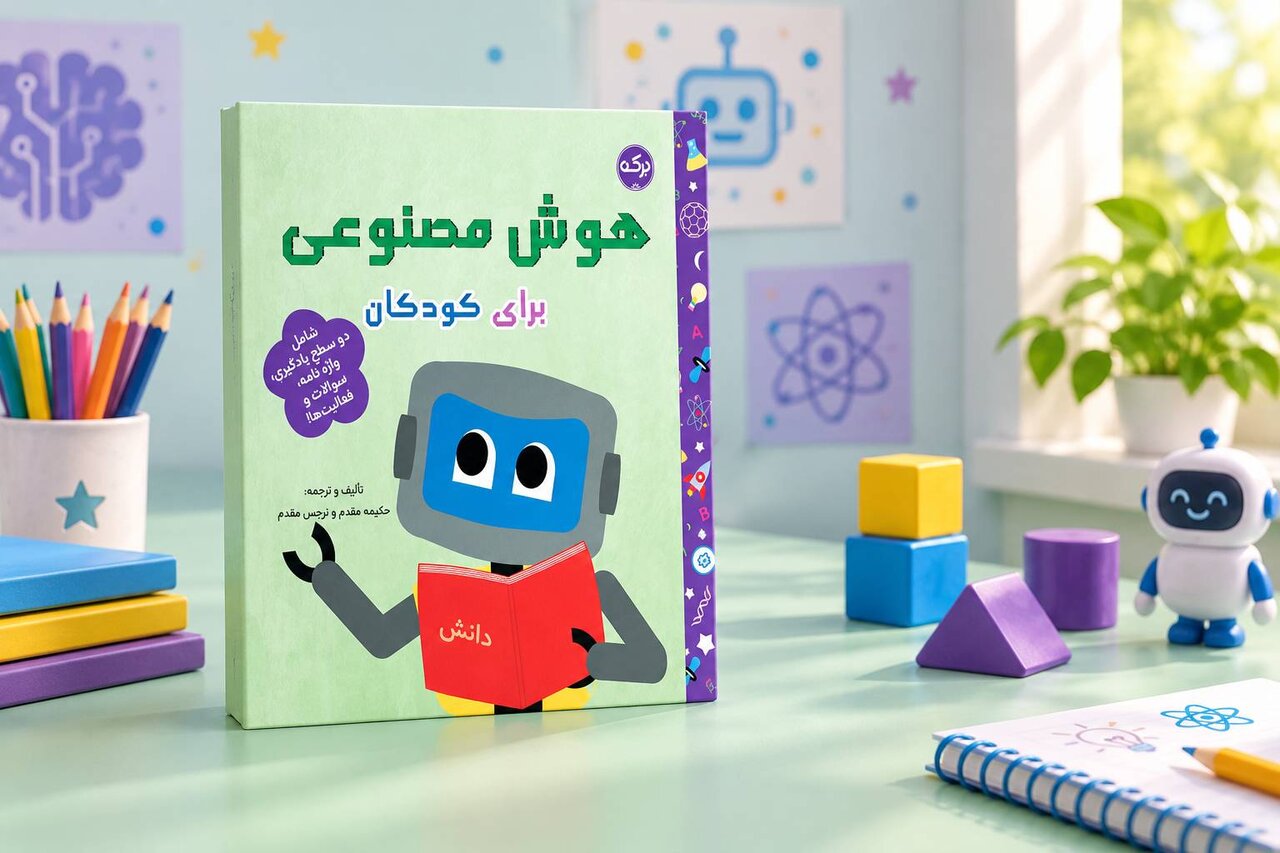
According to Mehr's correspondent, how can machines recognize the image of a cat? How does a voice assistant understand our voice and answer our questions? Do robots learn like humans too? These questions are part of the world of technology that today's children encounter more than in the past. The book "Artificial Intelligence for Children," written by Dutt, translated by Hakimeh Moghaddam and Narjes Moghaddam and published by Barke Publishing, tries to answer these questions and explain the complex concepts of artificial intelligence to its child audience in simple language, with varied illustrations and tangible examples.
At a time when smart tools, voice assistants, robots and AI-based programs have become part of everyday life, children's familiarity with how these technologies work has grown more important. They may use tools every day whose capabilities are partly based on artificial intelligence, without knowing how this technology works or how it differs from human abilities. This book seeks to narrow the gap between everyday encounters with technology and scientific knowledge of it.
From Toys to Robots: What Is Man-Made?
Understanding artificial intelligence requires, before anything else, understanding the world around us and the tools humans have made. The book begins from exactly this point and, by explaining the difference between natural and artificial phenomena, invites children to observe their living environment more closely.
Along this path, the reader learns to distinguish between things that exist in nature and tools that are the product of human design and construction. This simple distinction is a prelude to entering the discussion of machines and robots, tools each made to perform a task or meet a need.
The book then deals with the concept of the machine and the robot and explains the role of energy in their functioning. The child is faced with the question of how a device works, what makes it move, and what difference there is between an ordinary machine and a device that can perform some tasks with the help of artificial intelligence.
This way of starting, instead of facing the reader with specialized terminology from the very beginning, draws on his or her familiar experiences and prepares the ground for understanding more difficult concepts.
What Is Artificial Intelligence and What Does It Do?
After becoming familiar with machines and robots, the book turns to its main concept: artificial intelligence. Explaining this technology to children without using understandable examples can be difficult, because many of its processes happen behind a screen or inside computer systems.
In this work, Dutt has tried, using tangible examples, to show how some machines can process information, recognize patterns and, based on the data they have received, provide an answer or a result. Here, artificial intelligence is no longer an inaccessible concept but becomes a set of capabilities whose examples the child can find in his or her everyday life.
The book also addresses the fact that some smart machines can perform tasks similar to seeing, hearing, reading, writing and answering. Yet becoming familiar with these capabilities provides an opportunity for children to also think about the difference between the functioning of a smart system and human abilities.
The goal of this familiarity is not merely to introduce new technologies; the child must be able to pose questions about what he or she sees and, instead of accepting machines' functioning as a magical phenomenon, seek to understand how they work.
How Do Machines Find Patterns?
One of the concepts raised in the book is pattern recognition and machine learning. These concepts are used in many smart technologies, but explaining them to a young audience requires simple language.
For example, distinguishing between different images or finding similarities among several objects can provide a basis for becoming familiar with the concept of a pattern. When the child realizes that machines need data and examples to recognize and categorize information, he or she gains an initial understanding of how some smart systems work.
Machine learning is also among the topics raised in the book. In this area, the child becomes familiar with the idea that some systems can use data and examples to perform a task better. Of course, machine learning does not mean learning exactly like a human; this very difference can be a topic of conversation between child and adult.
Addressing these concepts in the form of examples and images helps children become familiar with words that, in the future, when facing new technologies, they will hear again and again.
Natural language processing is another of the book's topics, an area of artificial intelligence concerned with machines' interaction with human language. Voice assistants and tools that can answer users' questions are familiar examples for explaining this concept.
Children may have experienced talking to a digital tool and hearing a response, or typing a question and receiving a result. The book uses such experiences to show how machines can process voice or writing and provide a response proportionate to the information received.
Alongside this topic, capabilities such as speech recognition, reading and writing are also raised. These examples show the child that artificial intelligence is not limited to moving robots and may be present in software and tools that look ordinary.
Becoming familiar with these applications provides a good opportunity for parents and educators to talk with children about the possibilities and limitations of smart tools and to explain the difference between a system's answer and human judgment.
A Book That Makes the Child Ask Questions
One of the features of "Artificial Intelligence for Children" is that its explanations are accompanied by questions and activities. The book does not settle for providing information; in various sections it poses questions so that the child thinks about the concepts read and takes part in the learning process.
This approach matters because familiarity with technology is not achieved merely by memorizing a few definitions. A child gains a clearer understanding when he or she can connect the concepts to personal experiences, find similar examples in the surrounding environment and ask questions about how tools work.
The existence of two levels of learning, a glossary and educational activities also helps organize the material. The glossary can be used to review key terms, and the questions and activities provide an opportunity to consolidate what has been learned. Parents and teachers can also use these sections to turn reading the book into a shared conversation.
In this way, in addition to conveying basic information, the book encourages the child to observe, compare and question, skills that matter when facing changing technologies and new tools.
The book "Artificial Intelligence for Children," translated by Hakimeh Moghaddam and Narjes Moghaddam, has been published by Barke Publishing in 36 pages.

Source: Mehr News Agency